

From Tunisia to shaping next-generation materials tech in Korea
이 글은 한국어로도 제공됩니다. 한국어로 읽기 →Meet Sahar, a Tunisian CSO at VanaM Inc. in Seoul. We sat down with her to learn about her journey from Tunisia to Korea, what it's like working in tech here, and why she believes more global talent should consider a tech career in Korea.
Profile snapshot
- Name: Sahar Ayachi
- Nationality: Tunisian
- Current role & company: Chief Strategy Officer (CSO) at VanaM Inc.
- Years in Korea: ~ 7 years (3 as student, almost 4 as employee)
- Visa status: E
- Languages spoken: Arabic, French, English, Korean, Spanish
- Previous countries worked in (if any): Germany
Background & career
Q. Can you briefly introduce yourself and your current role?
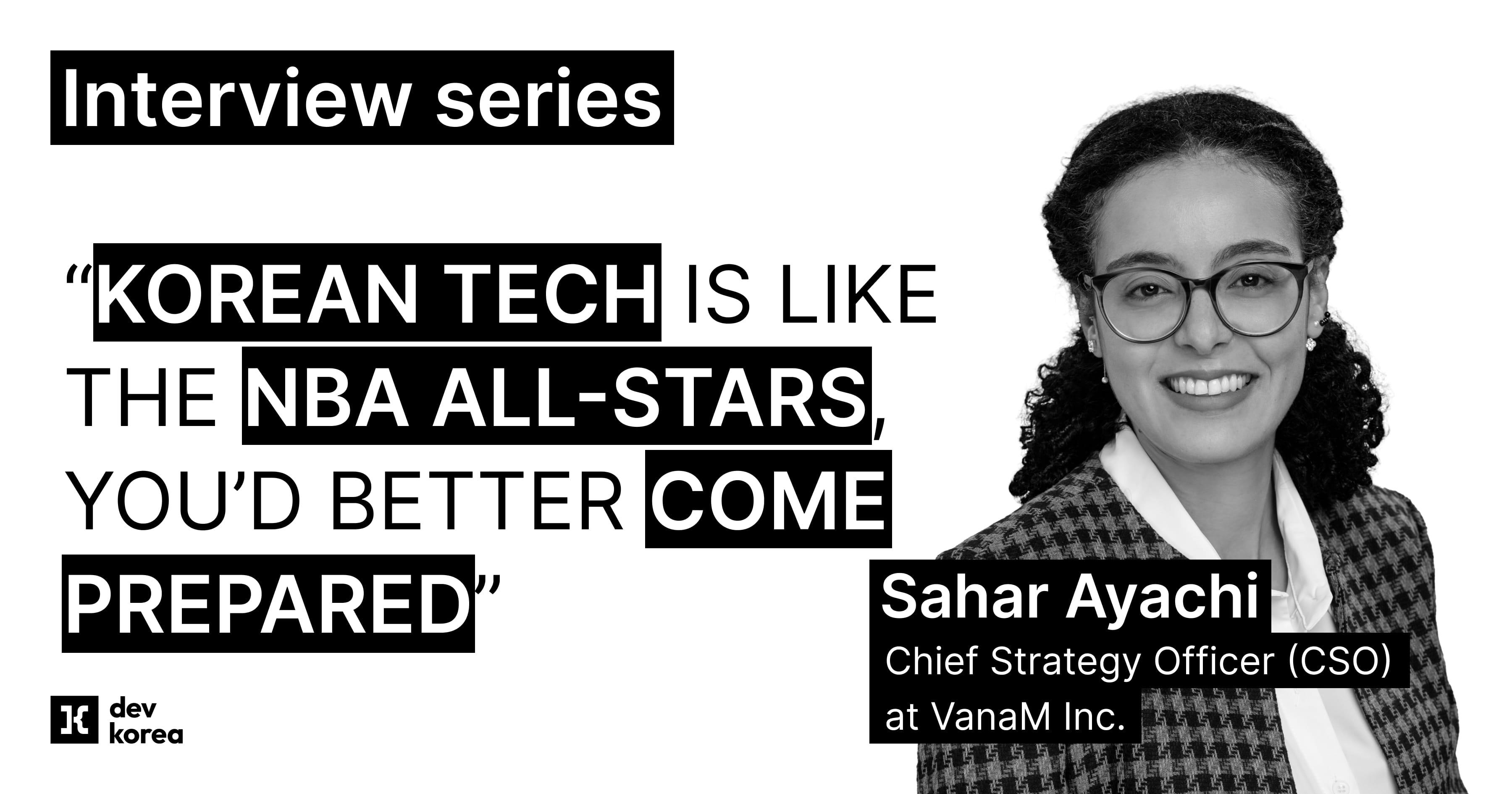
Sahar: My name is Sahar, I'm from Tunisia and I am currently the CSO at VanaM Inc., a South Korean startup specialized in thin film deposition where I lead global strategy and business development. My role covers international partnerships, investor relations and the establishment of VanaM's first international unit.
Q. What was your career path before moving to Korea?
I originally came to Korea as a transfer student midway through my bachelor's degree in engineering and completed my three years here. After that, I pursued a master's degree in Japan and later a PhD in Germany. I returned to Korea as a Research Professor with the intention of continuing in academia, until my career goals evolved.
Q. What inspired you to work in Korea?
Having lived in Korea before as a student and having experienced life and work in other countries, I felt that my chapter with Korea wasn't finished. That sense stayed with me, and eventually, I decided to come back.
Experience working in Korea
Q. Tell us briefly about your company (size, industry focus, notable achievements).
VanaM Inc. is a startup founded in 2022, specializing in thin film deposition and operating essentially as a next-generation materials foundry. We focus on developing and commercializing new materials for emerging technologies such as quantum computing, photonics and power electronics. One of our notable achievements for 2025 is being selected as one of 12 companies out of nearly 200 applicants for Cohort 8 of the NextCorps Luminate Accelerator, a New York State funded program focused on Optics, Photonics and Imaging (OPI).
Q. How did you find your current job? Was the hiring process challenging as a foreigner?
I found my current position through Linkedin. The process was very straightforward, likely helped by the fact that VanaM is a startup. It started with an initial email exchange answering a few more/deeper questions, then an interview with the management team, and later introductions to other team members. From the first contact to joining, the whole process took about 4 weeks.
The most challenging part was getting responses in general, and the need for specialized Korean knowledge. I had to prepare extensively and review a lot of terminology (technical and others) in Korean ahead of the interviews.
Q. Can you describe your typical workday?
A typical workday follows standard office hours, roughly 9 to 6. My tasks vary widely and include investor meeting preparation, partner and international coordination, as well as marketing and strategy. We also participate in many fairs and exhibitions, most of them abroad, which require extensive planning beforehand and follow-ups afterwards.

2025 was a particularly intense year for VanaM and myself, as, as mentioned above, we were selected for the NextCoprs Luminate Accelerator Program which required monthly in-person participation in the U.S. for six months, which significantly shaped my work weeks during that period.
Q. How does Korean work culture compare to your home country's?
I would describe Korean work culture as highly disciplined and more intense than that of my home country, without implying that one is better than the other.
Korean work culture is rooted in hierarchy, a strong work ethic, and high expectations which are often met with equally strong commitment and responsibility. Korea is an extremely fast-paced country, and that inevitably leads to a demanding professional environment. This can make integration more challenging for those unfamiliar with the culture.
That said, Korean work culture is also internationally recognized for its high standards, endurance and strong sense of duty, which are qualities that have clearly contributed to Korea becoming one of the most developed countries in the world. The "Miracle of the Han River" (which refers to the incredible transformation of Korea from a war-torn country to a world leading economy in a few decades) happened for a reason!
Q. Do you speak Korean at work? How is communication handled in your team?
I have TOPIK level 5 and have completed the KIIP program, so I'm fairly fluent, which is probably one of the main reasons I got my current job. Communication at work is almost entirely in Korean, though I sometimes mix with English when the topic is particularly complex. Most of my working documents are also prepared in English.
Q. What challenges have you faced adapting to Korea's work environment?
My experience with VanaM Inc. has been incredibly positive. Like any job, there are challenges, but none of those I've personally faced there stem from the Korean work environment itself. Every member of our current Management Team has spent some time abroad for work or study, so I believe that shaped our work environment in a way that was easier for me to adapt and integrate.
Before joining VanaM though, I worked as a Research Professor in academia for about 2.5 years. That's where I encountered challenges more closely tied to Korea's broader academic work environment. Graduate schools in Korea can be extremely competitive, which sometimes leads to difficult dynamics within teams. In some cases, team members don't work on related projects, which limits help and collaboration and creates a sense of isolation. I sometimes faced (and sometimes simply witnessed) these challenges firsthand.
However, I'd like to clarify that these challenges are not limited to foreigners, though language barriers and cultural adjustment certainly make them more difficult.
Lifestyle & community
Q. What's your life outside of work like? How have you built your social life here?
When I first came to Korea as an undergrad, my social life was very much that of a student. Easily making friends, going out, having fun. When I returned in 2022 for work, I was lucky to already know people, so re-building a social life wasn't too difficult.
Most of my friends are expats around my age, so late 20s to 30s, and despite my heavy business travel schedule, we try to meet regularly.
Until this year, I was also more active in sports and exploring Korea's cultural scene (galleries, musicals, classical music…), but that slowed down significantly this year. I am hoping to get back to it soon.
Otherwise, I am your fairly typical introvert. I love reading, staying at home, resting and binge-watching shows over the weekend.
Q. How much has knowing Korean (or learning it) helped in your daily life?
100%! No doubt!
Korea, like many other countries, has its own language with its own structure and characteristics, and knowing it is essential to living here comfortably. Honestly, this applies everywhere. I don't think it's realistic to come to Korea and expect to live comfortably using only English.
English can definitely help sometimes, especially for short visits, but a long-term plan in Korea without Korean will only make your own life difficult.
Q. What was your biggest culture shock when you first arrived?
I don't think I experienced a single massive culture shock, which honestly surprised me. I even tried looking for one back in 2011, because it felt strange to move from Tunisia to Korea and not have that one defining shock. Despite the many differences, I think I was more surprised by the similarities, and perhaps that made me accept the differences with a more open mind than I expected.
That said, one thing that really stood out to me was the after-work drinking culture, how intense it could be and how mandatory it sometimes felt. That was definitely something that marked me. I know it has also become much less intense now, but at the time, it was a big surprise.
Reflections & advice
Q. Do you plan to stay in Korea long-term, and how do you see your career evolving here?
"Long-term" feels too far ahead to plan, but I can definitely see myself staying in Korea for the next few years. A big reason is my company. I really love my current job and I want to grow alongside our startup, scale it significantly, and hopefully take it to a very successful exit.
Q. What tips would you give to someone searching for a tech job in Korea?
Learn Korean! Yes, tech and science fields are more open to English compared to other sectors, but your day-to-day life will be much easier if you can communicate comfortably with your colleagues.
Technical and scientific knowledge is essential, of course, but that's something you will keep building throughout your career anyway. You'll always be learning new technologies. So, make your life easier by starting with a solid level of Korean, so you can focus your energy on the job itself. It really helps level the playing field.
Q. What can Korean companies do to better support and integrate international employees?
This might sound like a contradiction to what I've been saying all along, but being more open to using English and being a little more patient could make a huge difference. That doesn't mean everything needs to be done in English or everyone needs to speak it fluently. But it would help immensely if team leaders and colleagues were willing to give new international hires the time and space to adapt, to be patient with their evolving language skills, and to show understanding when they encounter challenges that may seem intuitive to Koreans. The best example I can think of here is how difficult it can be to write a formal or official document in Korean, even for advanced levels. In my case, I still mix English and Korean for paperwork, and get help from my colleagues sometimes.
Another helpful initiative would be a mentor-mentee system. It doesn't need to be mandatory, but a structured program that pairs willing Korean employers (or experienced foreign employees) with international newcomers would greatly support integration.
Q. What's one thing you wish you knew before moving here?
Having first moved here 15 years ago, and with Korea now feeling like home, it's honestly hard to say. Maybe I wish I knew how much university exams relied on memorization? That might have potentially saved me hours of extra studying and improved some of my grades. But at this point, I'm not even sure anymore!
Q. Would you recommend Korea to other international tech professionals, and why?
If you are willing to put in the work, absolutely. If you come with an open mind, aware that you're stepping into one of the most demanding environments with very high standards, and ready for that, then yes.
Korean tech is like the NBA All-Stars. You'd better come prepared!
Rapid fire
- Favorite Korean food: 된장찌개 (Doenjang-jjigae, a soybean paste stew)
- One must-visit place in Korea: Namsan Tower, in winter, at night. Preferably on a snowy day.
- Most surprising thing about Korean tech culture: how fast it changes!
- Favorite Korean word or phrase: 알았어! (arasso meaning "Ok! Got it!")
Connect with Sahar Ayachi
- LinkedIn: /in/ayachisahar
If you want to be next and contribute, send us an email at [email protected].
Ready to explore your next move? Visit Dev Korea to check the latest job openings, or if you're an employer, post a job and connect with our vibrant community of tech talent eager to contribute to Korea's innovation ecosystem.