AI: Clarity amongst hype, uncertainty, and instability: K Choi on what LLMs really are, and staying sharp with AI
이 글은 한국어로도 제공됩니다. 한국어로 읽기 →Want to feel what the night was like? From the talk to the networking and everything in between, here's the aftermovie from AI: Clarity amongst hype, uncertainty, and instability 🎥.
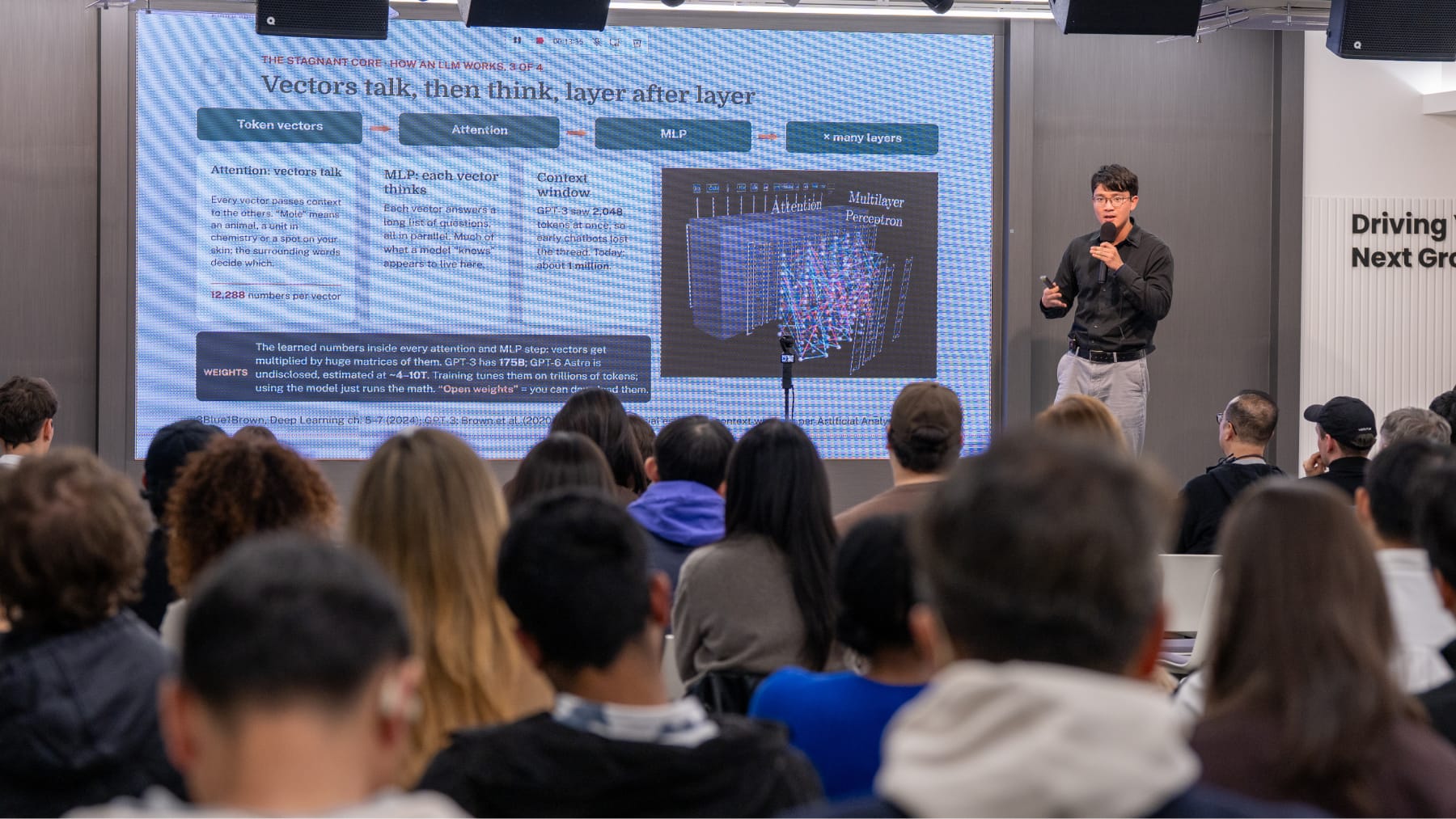
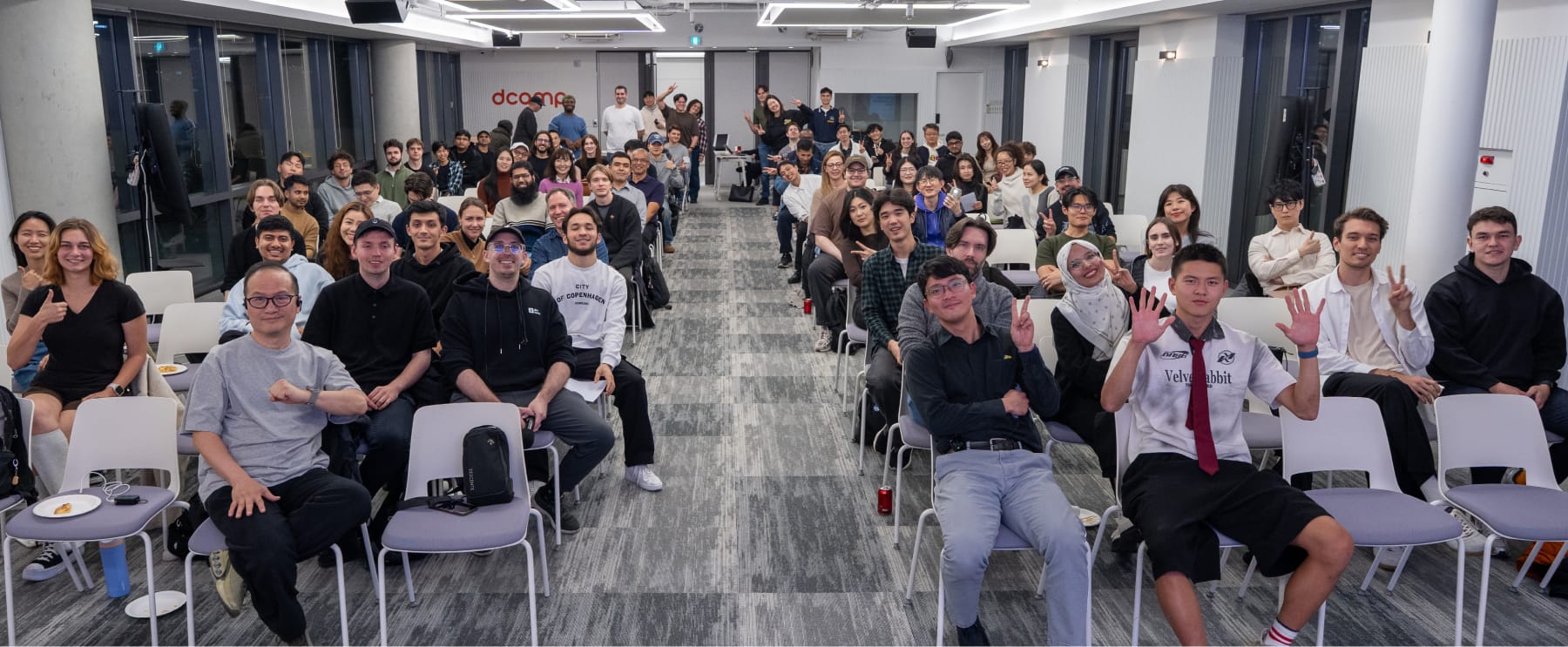
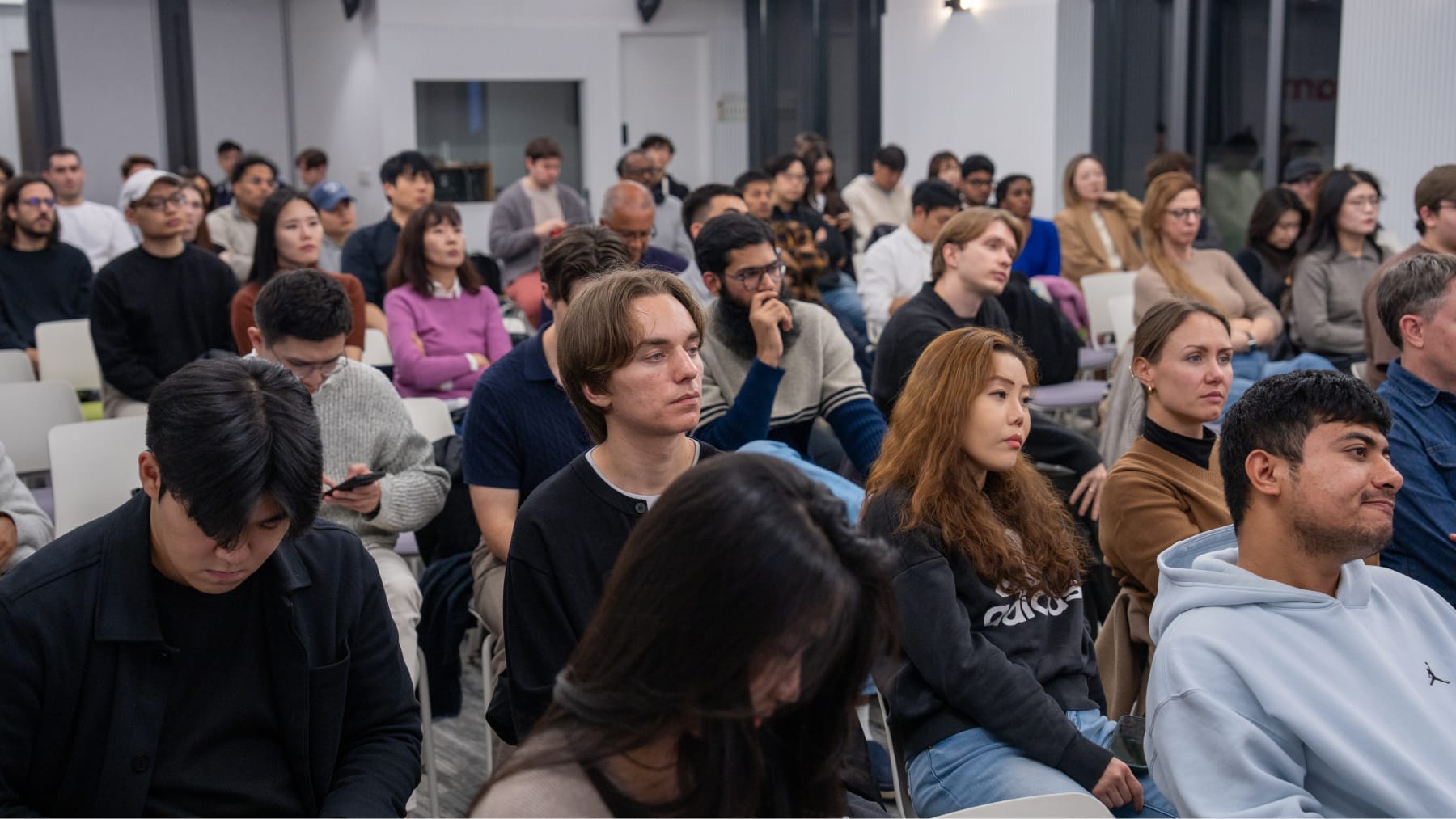
On October 29 we ran AI: Clarity amongst hype, uncertainty, and instability at dcamp Seolleung. More than 100 people came out for a single talk that ran over an hour and a half, and almost nobody left early.
The speaker was K Choi, an AI/ML engineer at eMoldino, a Korean manufacturing startup, who also runs the weekly freeCodeCamp Korea meetups. His starting point was simple: everybody is talking about AI, at cafes, in convenience stores, on park benches. Very few people actually understand it. And when nobody understands something, the hype, the fear of missing out and the confidently wrong takes fill the gap.
So he set out to give the room a few grounded truths, while being upfront about which parts were his own reasonable assumptions.
Nine years on the same core
He started by asking who knew what a transformer is. Four or five hands went up. His answer: if you've ever used ChatGPT or Claude, you've used one.
The architecture came out of Google's "Attention Is All You Need" paper in 2017, and everything since, from ChatGPT's launch in November 2022 to longer memory, tool use and reasoning, still sits on that same core. Nine years later, nothing has replaced it.
He walked through how it works, step by step: text is chopped into tokens, each token becomes a long vector of numbers, and layer after layer of attention lets every token pull context from the others, so "mole" can mean an animal, a unit or a spot on your skin depending on the sentence. Capabilities nobody explicitly programmed appear once you scale that up enough. His analogy: a glass of water is transparent, an ocean of it is blue.
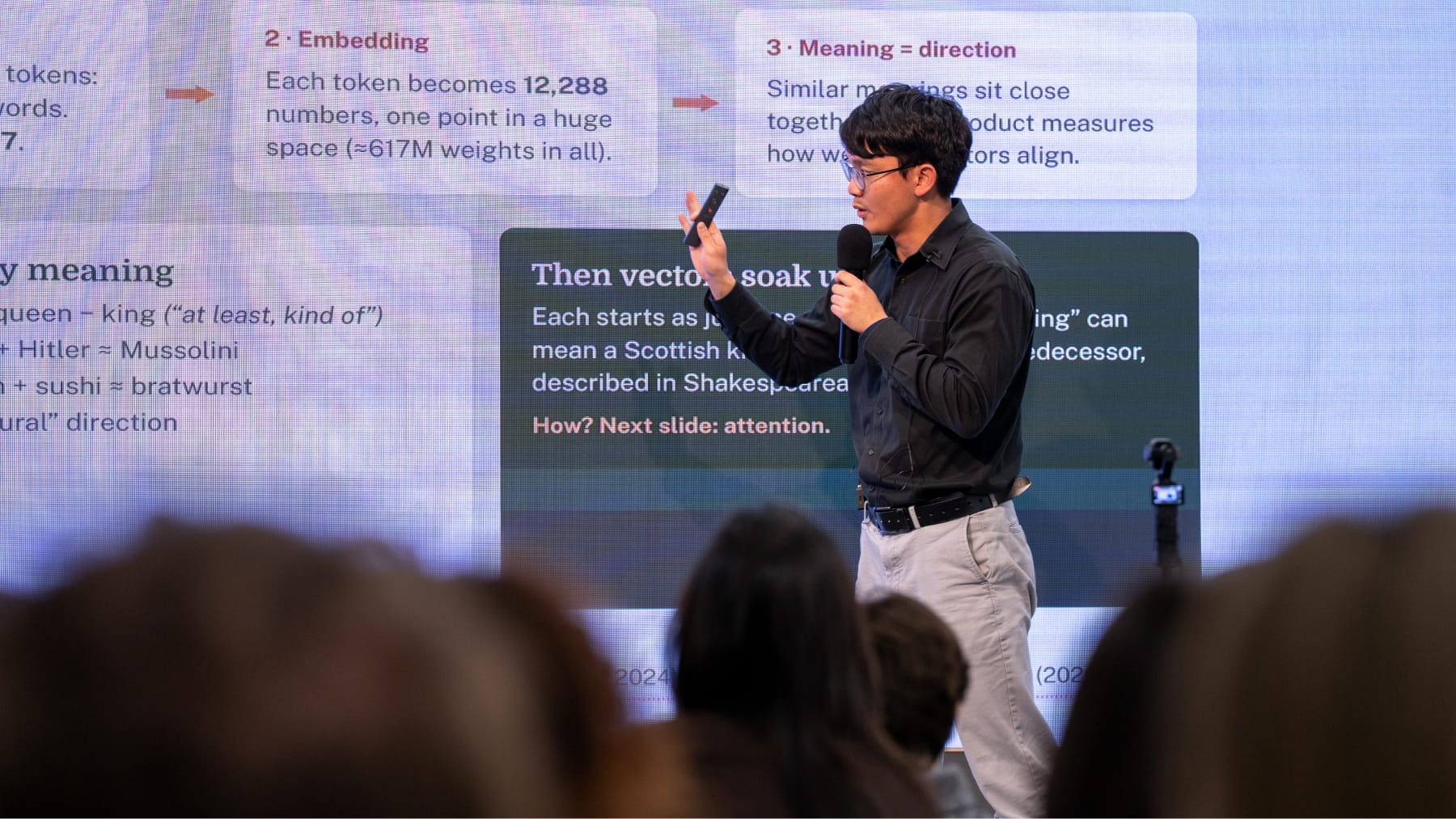
The part that matters most for everyday use is the output. A model doesn't give you an answer, it gives you a probability for the next token. Temperature adds randomness, which is why you can ask the same question twice and get different answers. Even at zero temperature you get the most likely token, not the objectively true one. Hallucination is baked in, and grounding and retrieval reduce it without removing it. His proof: every AI provider still prints "can make mistakes" under the chat box. When they remove it, he'll take it back.
He also covered the newer "System 1" models like Jev, which made headlines for not being able to hallucinate. His take: you define the possible answers up front, a score, a choice or a null, so the model can't invent a fifth option. That makes it fast and cheap, but the format being guaranteed doesn't mean the answer is correct. His best guess, based on how competitors have built theirs, is that underneath it's still a transformer with an answer menu.
Benchmarks, releases, and what's actually new
Next he went after the numbers in the headlines. When a lab announces a near-perfect benchmark score using its own harness, and a standard harness gives a far lower number on the same model, he wants to see how they got there before being impressed. He pointed to SWE-bench Verified being retired because frontier models had memorized the original fixes, and argued that if you give a student the answers to a test, you shouldn't be surprised by the score.
Then the timeline. Sora launched and was shut down a little over two years later because video generation was too expensive. MCP isn't even two years old. "Vibe coding" was coined less than two years ago. A new frontier model had been released 17 hours before his talk, and nobody in the room had used it yet. His point: nobody can keep up, and that's fine. He doesn't try to follow everything, only what's relevant to his work.
He also shared his view, clearly labeled as an assumption, on how some open-weight models get so close to frontier models at a fraction of the price: using larger models to generate training data and distill it into smaller ones.
AI amplifies seniority
This was the section most developers in the room came for. His argument: coding agents amplify what experienced engineers already have, good CI/CD, test automation, clean architecture, deep domain knowledge, precise specs and rigorous code review. That's why juniors are struggling more in today's market.
His advice for getting senior faster is to treat the LLM as your junior. You set the direction, own the architecture, specify precisely and review ruthlessly. You hold the context it can't: the why, the history, the meetings, the people. And you stay accountable for what you ship.
He listed where LLMs are still weak:
- Legacy code. They thrive on greenfield projects. Every impressive demo he's seen is a new project, never an eight-year-old Java 8 codebase.
- Integrations. Wiring systems, vendor APIs and data contracts together.
- Genuinely new problems that aren't in the training data.
- Knowing their own confidence. Ask "are you sure?" a hundred times and the answer keeps changing.
- Long, multi-step work, where small mistakes compound.
- Validating their own output. A model that writes the code and the tests can get both wrong in the same way.
Then he flipped the usual line around. Instead of "use AI or get left behind", he argued that leaning too heavily on AI degrades the exact skills that make you competitive: debugging instinct, design judgment, deep recall, starting from a blank page, and above all validating results. He backed it with a series of studies where people did better with AI and worse once it was taken away.
His own habits:
- One hour a day at work without Claude Code, reviewing and debugging by hand
- Putting his work in front of teammates for real feedback
- Finding the difficulty that gets him into a flow state
- Verifying before trusting, with tests he wrote himself
- Learning new tools from the docs. When Jev came out, he read the docs line by line and tested it himself before recommending it to his company
- Teaching what he learns, because where you stumble shows what you don't really know
He tied it back to principles that are decades old: the Pareto principle, the mythical man-month (adding infinite junior agents won't hit the deadline), Goodhart's law and the cobra effect.
The economics behind the hype
He then turned to money, with a clear disclaimer that it wasn't financial advice. In his reading, today's subscriptions are heavily subsidized to bring people in, the way a cheap rotisserie chicken brings you into the store, and limits get tighter over time. His advice: don't build your whole workflow on a subsidy, and have an alternative ready.
Going through the IPO filings, his takeaway was that serving the models can be profitable, training is what burns the cash, and the growth needed to cover compute commitments is a big part of why there's so much hype. So when a dramatic headline comes out of a frontier lab, keep the incentives in mind.
On the claimed math breakthroughs, he offered his own framing: LLMs work well in an "extrapolation zone" next to the edge of human knowledge. Tech got infinite juniors, and research just got infinite grad students. The best people get amplified, but humans still have to verify the output.
When people trust AI too much
The heaviest part of the talk was about real consequences: confidential data pasted into public chatbots, a chatbot inventing a refund policy a company was then held to, reports citing studies that don't exist, a coding agent deleting a live environment, and people following AI advice on health, the law and the outdoors.
He was most concerned about the people who get hurt first: teens, isolated people and anyone in a vulnerable moment. His message was that AI is not a person or a friend, that companies selling it as a replacement for people need to be held accountable, and that we have a responsibility to teach kids the same lesson we learned online: keep private things private, and ask a trusted adult.
Where AI should go
He didn't end on doom. AI isn't going back in the bottle, so he wants it pointed at the right things: content moderation so fewer people have to see the worst of the internet, repetitive document work, white-hat security research, accessibility tools for blind and low-vision users, science like AlphaFold, and medical screening that catches more cancers.
And he has hope, because people adapt. His generation learned the internet's rules in real time, and he believes kids growing up with AI will learn its limits too.
Then the surprise ending: he's also a rapper, Helix, with a first track on the way and an open mic that weekend. He handed out flyers.
Q&A
- Using AI for research: a product designer asked if it's fine to have an LLM gather sources as long as it links them. His answer: yes, as long as you actually read the sources, and use plain search too.
- What's the incentive for juniors? A PhD student in AI asked why new grads should still learn to reach senior level. K's answer: seniors have become more valuable and can do more. The student pushed back that it might be like telling people to learn to ride horses when cars arrived, and that time will tell.
- Duplicate research: someone asked whether several teams working on the same cancer screening idea is wasted effort. K disagreed: reproducing results is valuable, especially in health.
- "90% of code is written by AI": asked about frontier labs saying most of their code is AI-generated, he said that to him that just means the digital juniors are writing the code, and pointed to Anthropic's own study where employees could fully delegate only a small share of their work.
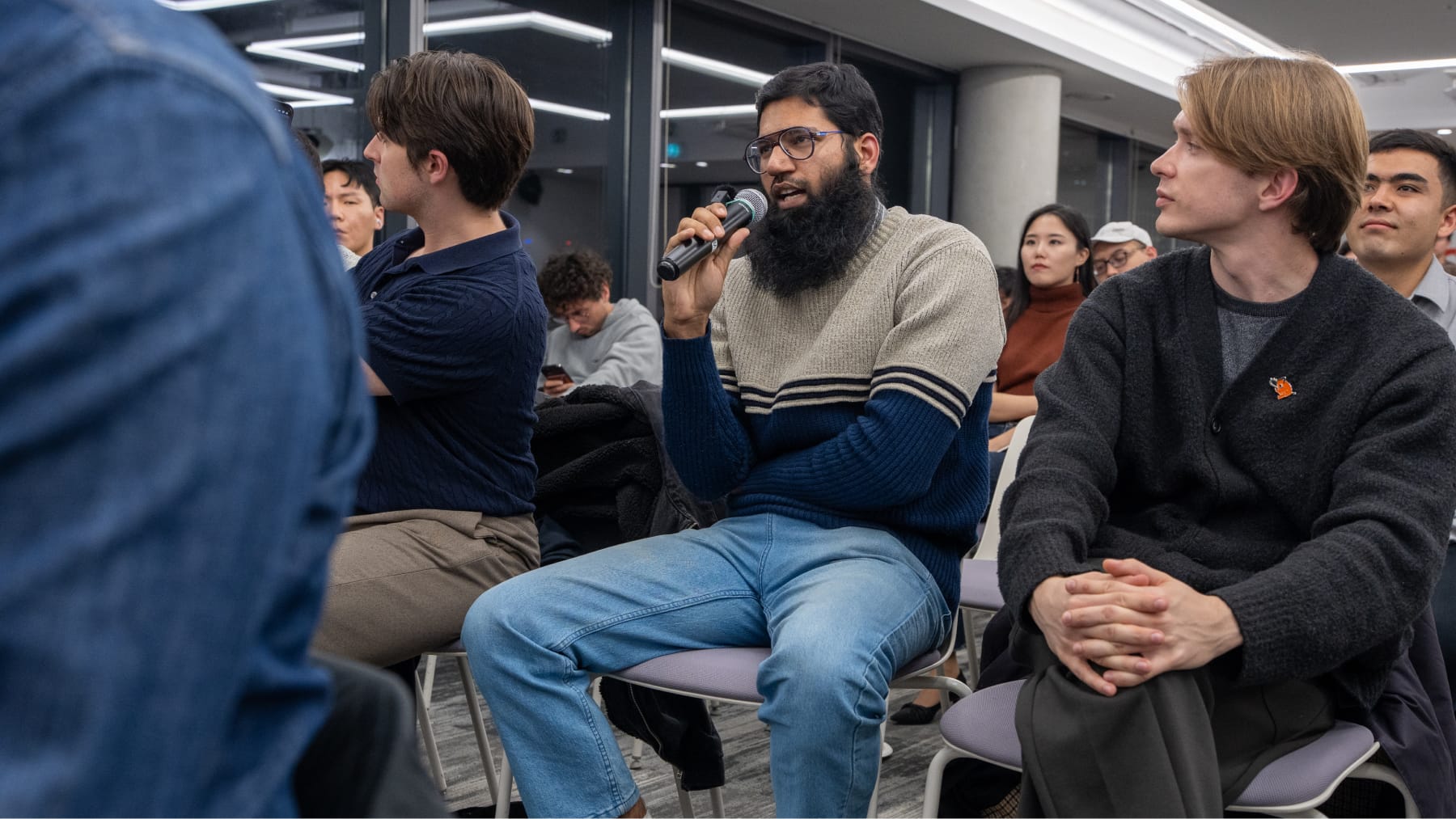
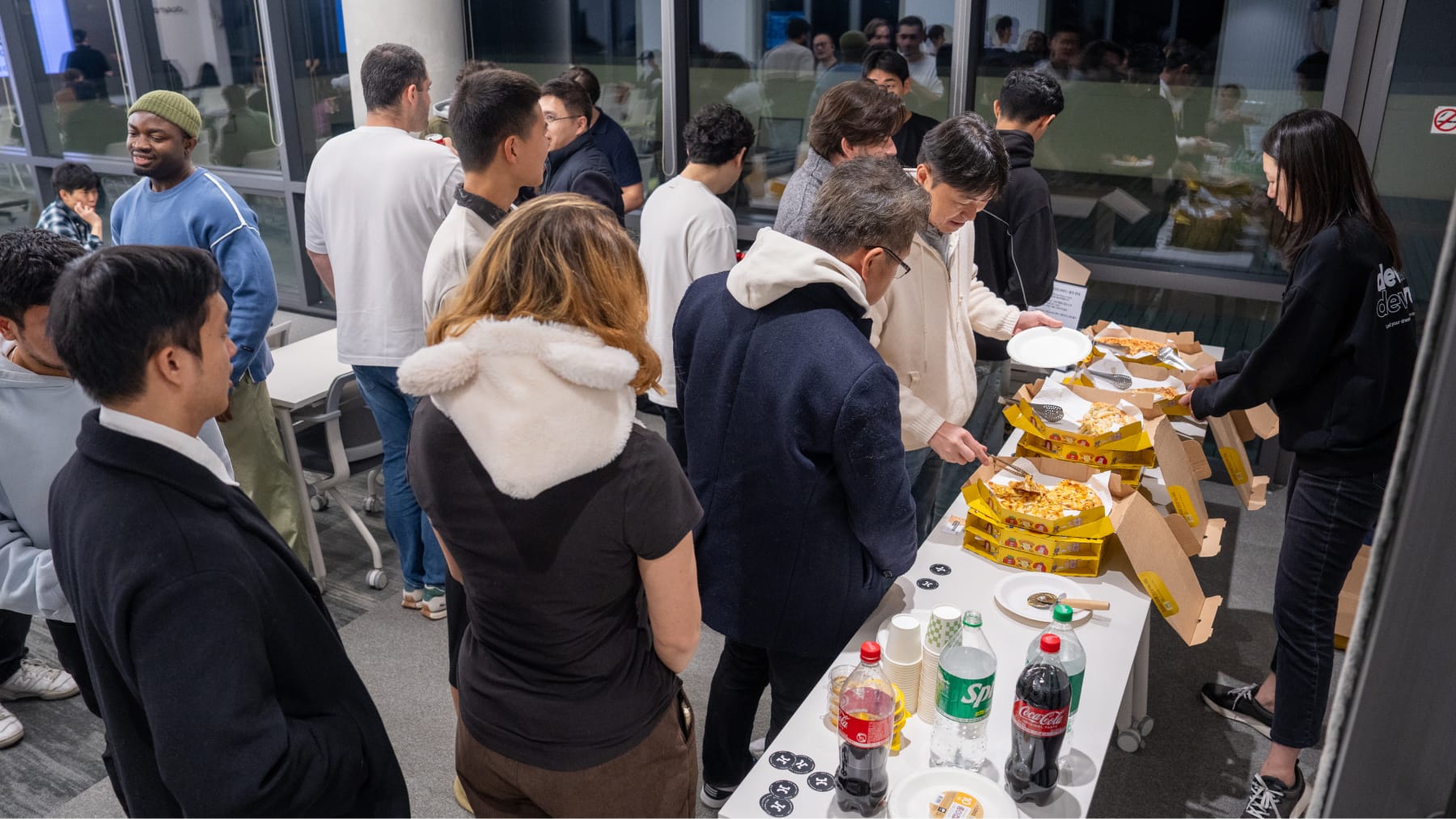
The room
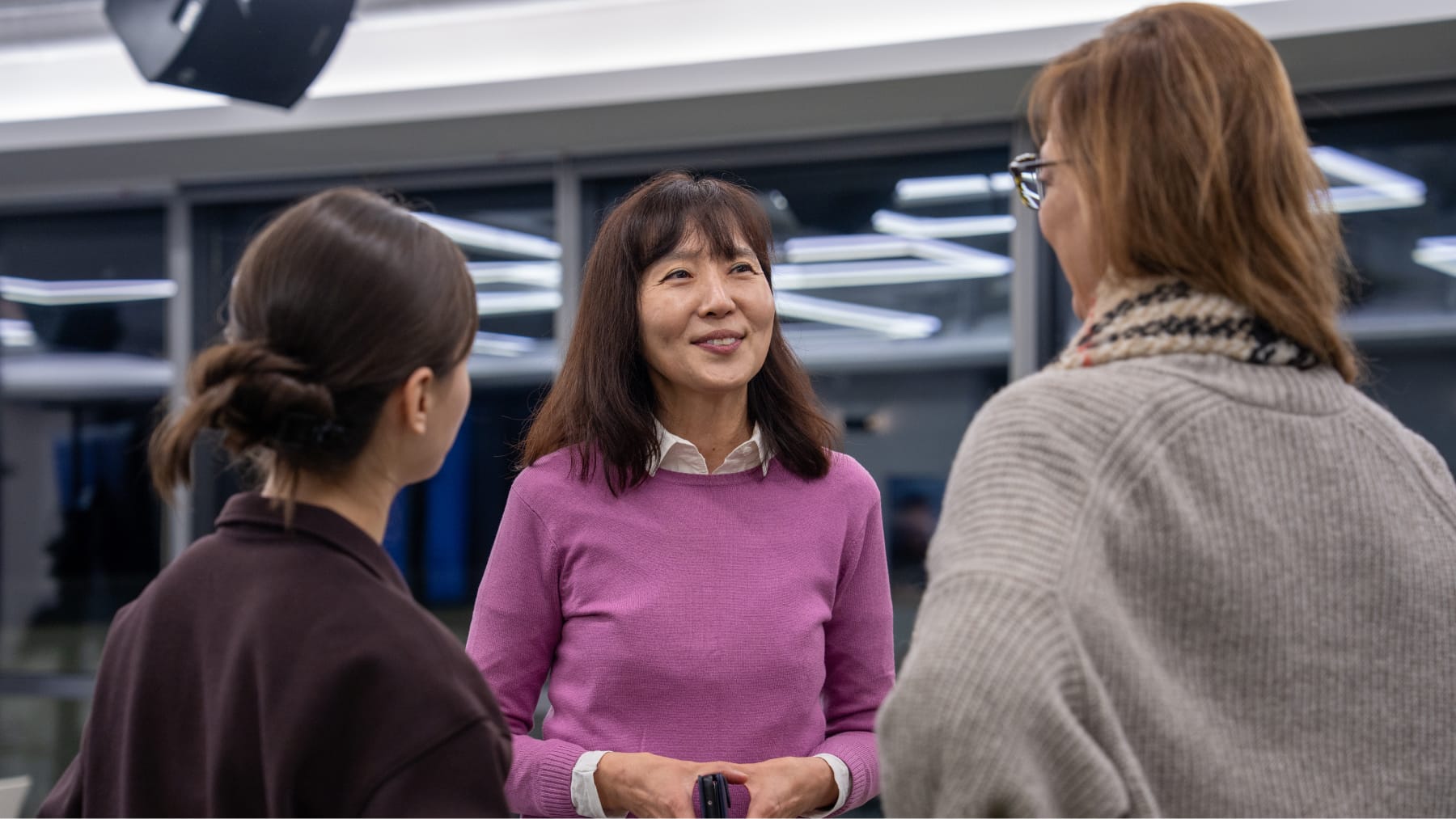
We started with check-in and food, the usual pizza and burgers, with the burgers from Cry Cheeseburger. After the talk, people stayed for networking until closing.
Huge thanks
This event wouldn't have happened without:
- K Choi for a talk that made people think harder about AI, not just get more excited about it
- dcamp for hosting us at Seolleung
- Our annual sponsors Habsida, Figma, Rezi and Notion. There was no event sponsor this time, so they're the reason there was food on the table
- Cry Cheeseburger for the burgers
- The volunteers who kept the night running: Azizjon, Bertijn, Brian, Nathaniel, and Rich, who also shot the aftermovie
- And all 100+ of you who came, listened for an hour and a half, and asked great questions
Watch the talk
The full talk is online:
You can find every published Dev Korea talk on our talks page.
See you at the next one.
Ready for your next move?
Visit Dev Korea to explore the latest job openings at dev-korea.com/jobs, or if you're hiring, post a job at dev-korea.com/post-a-job and connect with our growing international tech community.