



How I exchanged my French driving license for a Korean one (2026)
이 글은 한국어로도 제공됩니다. 한국어로 읽기 →I passed my driving test in France in 2013, when I was 18. Then I moved to Japan, then to Korea, and for years I simply didn't drive. No car, no need. After more than three years in Seoul, the public transport here makes owning one feel almost redundant.
But at some point you want to get out of the city. A weekend in the countryside, a trip somewhere the KTX doesn't reach, a drive along the coast. And that's when you discover that a French license in your wallet does nothing for you here. I'd never bothered getting an International Driving Permit before leaving France, and even if I had, an IDP only covers your first year in Korea anyway, so mine would have run out long ago. To drive here as a resident, you need a Korean license.
The good news is that around 130 countries appear on KOROAD’s acknowledged list. If yours is one of them, you exchange your license for a Korean one instead of testing for it: no road test, no driving school, no 500,000 KRW package. Most acknowledged countries are also exempt from the written exam, though not all of them, so check yours before assuming. More on that at the end.
The less good news is that the paperwork around it is where people get stuck. Not the license itself. The certificate you didn't know existed, the embassy that stopped issuing the document KOROAD asks for, the photo size.
I just picked up my Korean license, so while the whole thing is still fresh in my head, I wanted to write down exactly what it took. Hopefully it saves someone else a wasted trip.
First: does this apply to you?
This article covers the exchange route (면허 교환), not the full test route. You can use it if:
- You hold a valid, full foreign driving license (learner, provisional, probationary and temporary permits don't count)
- Your license was issued by a country Korea has a mutual recognition agreement with
- You're a registered foreign resident in Korea (if you've been here under 90 days without an ARC, you can't exchange)
A few limits worth knowing up front:
- Only car licenses are exchanged. Motorcycle and truck categories are not transferred. Those require taking the Korean practical exam.
- You'll typically receive a Class 2 ordinary license (2종 보통), which is fine for a normal car but won't cover vehicles like a 9+ seater van (Carnival, Starex).
- Your foreign license is surrendered. You hand it over at the counter and sign a consent form agreeing to it. You can get it back, but there are conditions. More on that below.
If your nationality is different from the country that issued your license, there's an extra condition: you have to prove you stayed in that country for more than 90 days, using school or employment records, a tax invoice, a permanent residence card, citizenship, or a long-term visa of over a year.
The documents
This is the part that determines whether you walk out with a license or walk out with nothing. The Gangnam office has the full list posted at the counter, and it's worth photographing when you arrive:
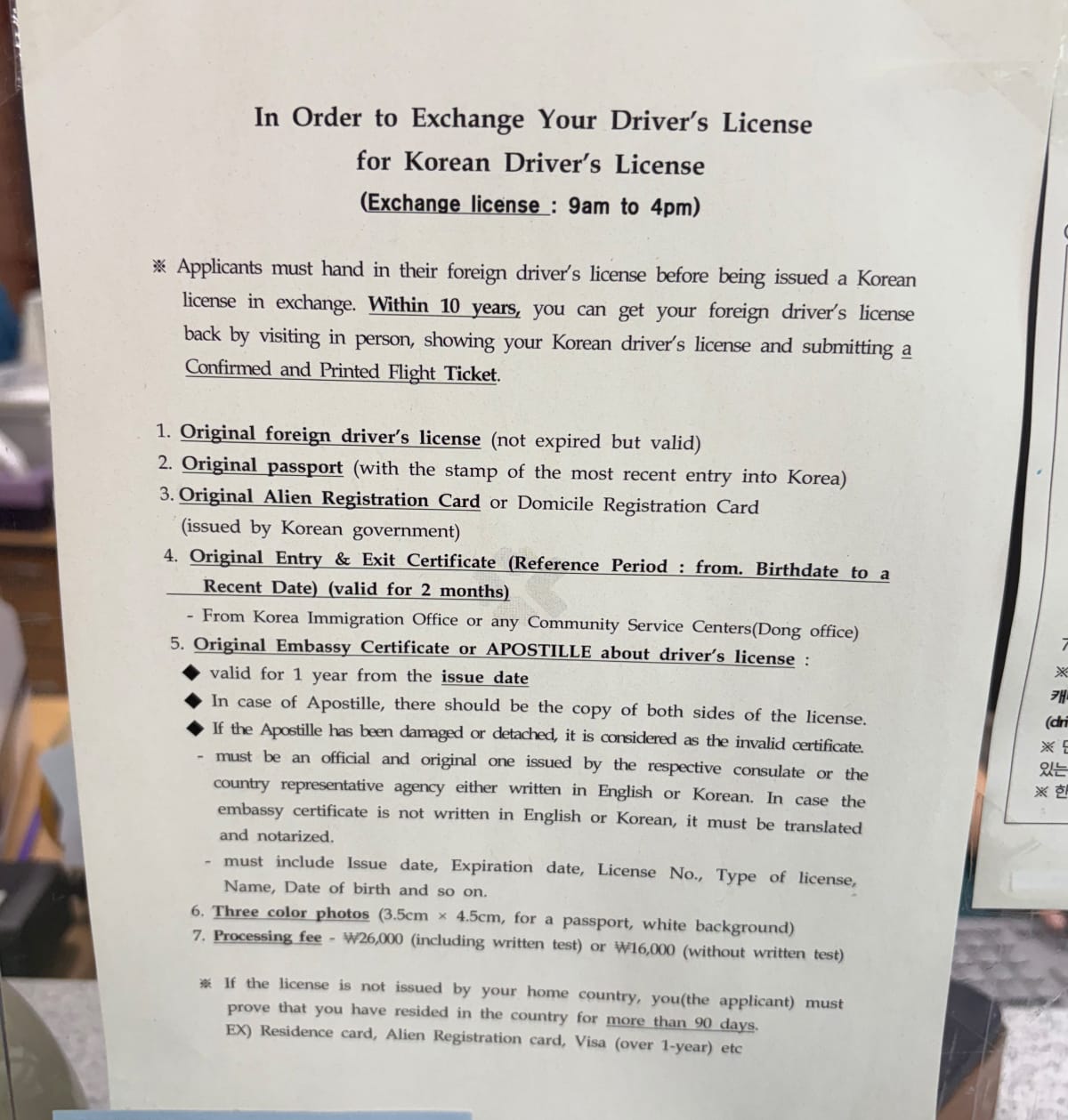
- Original foreign driver's license, valid and not expired
- Original passport, showing the stamp of your most recent entry into Korea
- Original Alien Registration Card (or Domicile Registration Card)
- Original Entry & Exit Certificate, reference period from your birthdate to a recent date. Valid for 2 months.
- Original Embassy Certificate or Apostille about your license. Valid for 1 year from its issue date.
- Three color photos, 3.5cm × 4.5cm, passport style, white background
- Processing fee
Two of those validity windows matter a great deal for planning, and I've not seen them mentioned in any online guide:
- The entry/exit certificate expires after 2 months. Don't get it early.
- The embassy certificate is good for a year. So the correct order is: sort the embassy paperwork first, then get the entry/exit certificate shortly before your visit.
The notice also spells out what an acceptable embassy certificate or apostille looks like, and the requirements are stricter than you'd expect. It must be an official original from your consulate or country representative agency, written in English or Korean. If it's in another language, it has to be translated and notarised. It must state the issue date, expiration date, license number, license type, your name and your date of birth. For apostilles specifically, a copy of both sides of the license must be included, and if the apostille has been damaged or detached it's treated as invalid. Don't unstaple anything.
Let me break down the two that actually cause problems.
1. The embassy certificate (or apostille)
Korea needs proof that your license is genuine. Depending on your country, that means either a certificate from your embassy in Seoul, or an apostille from your home country.
For French citizens, this is a two-stage process, and the first stage is the one that catches people out.
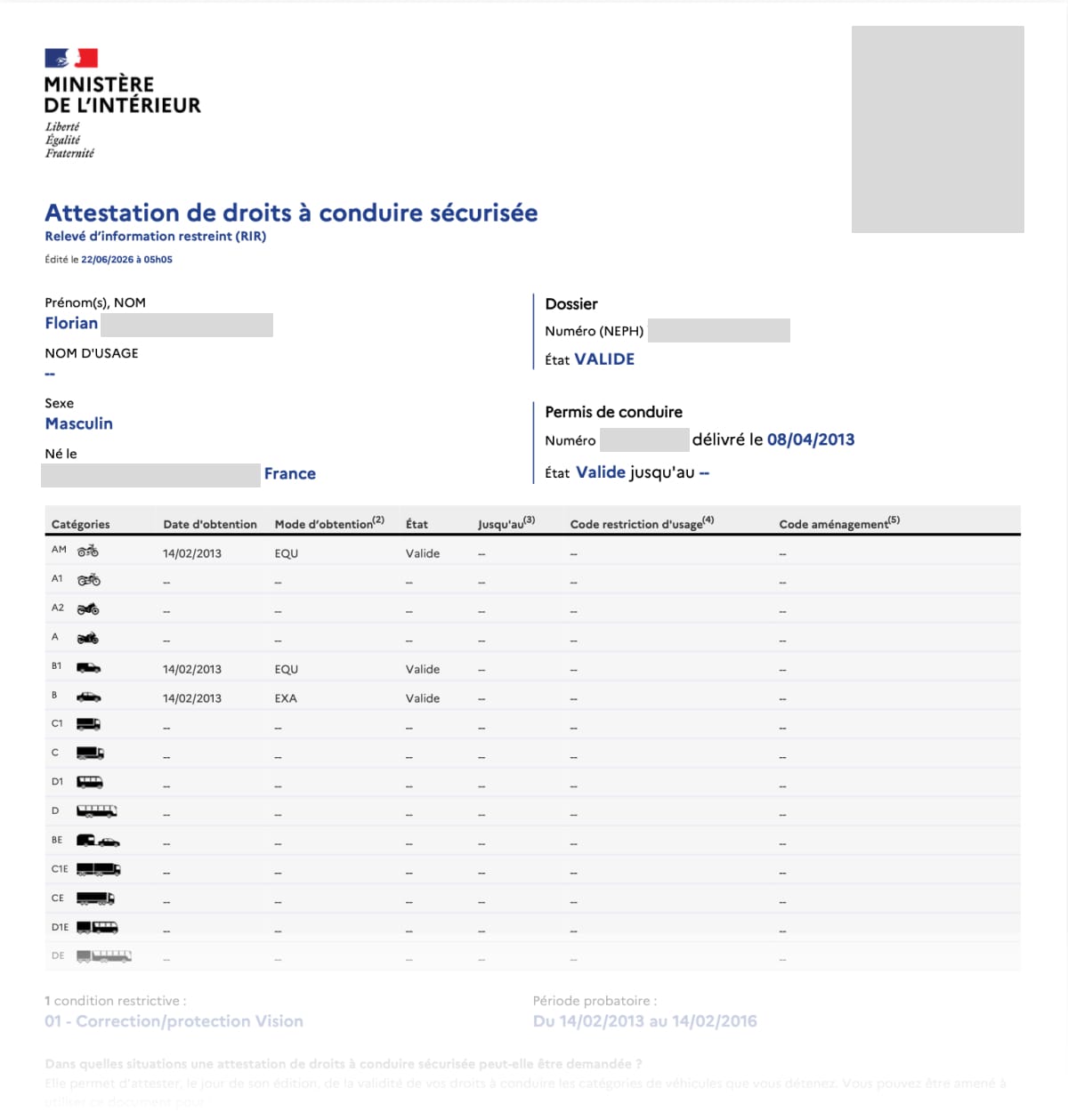
What the Korean authorities want is a document certified by the embassy confirming that your license is valid and that the driving entitlements attached to it are current. To issue that, the embassy needs your ADCS, the attestation de droits à conduire sécurisée (also called the relevé d'information restreint). You request the ADCS yourself from France, via service-public.gouv.fr. Nothing at the embassy can start until you have it in hand.
The age of your license doesn't matter here. Mine dates from 2013 and had sat unused in a drawer for years. What matters is that your entitlements are still live, and the ADCS is precisely the document that proves it.
Once you do, the certificate request goes to the consular section in Seoul by post. There's no counter appointment for this. You send:
- The original of your French license. Not a copy. It goes in the envelope, and it comes back to you together with the certificate.
- Your ADCS
- A copy of your passport
- The chancellery fee, paid by postal money order (통상환증서)
- A stamped, self-addressed envelope for the reply
Posting your original license is uncomfortable, and it's worth knowing in advance so you're not caught off guard. If needed, use a tracked service for the outbound envelope, and be aware you'll be without your license for the duration of the round trip.
The request itself can be written on plain paper. There's no form to fill in.
The fee: 69,720 KRW if you're registered on the consular register (inscrit au registre des Français établis hors de France), 139,450 KRW if you're not. I was registered, so I paid the lower rate. That's a 70,000 KRW gap for something that costs nothing to sort out, so if you're a French resident in Korea and haven't registered with the consulate, do it before you send this request. Note that these amounts can change on the 1st of any month, so check the embassy page before you buy the money order.
Postal address:
Ambassade de France en Corée (permis de conduire) 43-12 Seosomun-ro, Seodaemun-gu, Séoul 03741 주한프랑스대사관(운전면허증) 서울특별시 서대문구 서소문로 43-12 (우) 03741
So the realistic sequence for a French license is: request the ADCS from France → post everything to the embassy → wait for the certified document to come back by mail → then book your morning at the license center.
A critical warning for other nationalities. Several embassies in Korea have stopped issuing license confirmation documents, and applicants from those countries are directed to submit an apostille instead. As of writing, KOROAD's guidance names the American, British and Finnish embassies among them, and the British government has confirmed its embassy no longer issues validation letters.
If that's you, here's the part that hurts: apostilles cannot be processed inside Korea. You have to arrange it in the country that issued your license, which usually means enlisting someone back home or using a paid service. This is the step most likely to add weeks to your timeline, so start it before anything else.
Which embassies are affected changes over time, and I'm only in a position to vouch for the French process. So before you do anything, check two things: KOROAD's current guidance, and your own embassy directly. KOROAD explicitly advises that if your embassy hasn't published a notice suspending the service, you should contact them in advance to confirm they can still issue a certificate.
2. The Certificate of Entry & Departure (출입국사실증명서)
It's a record of every time you've entered and left Korea, and KOROAD needs it to verify that you were actually living abroad when your license was issued.
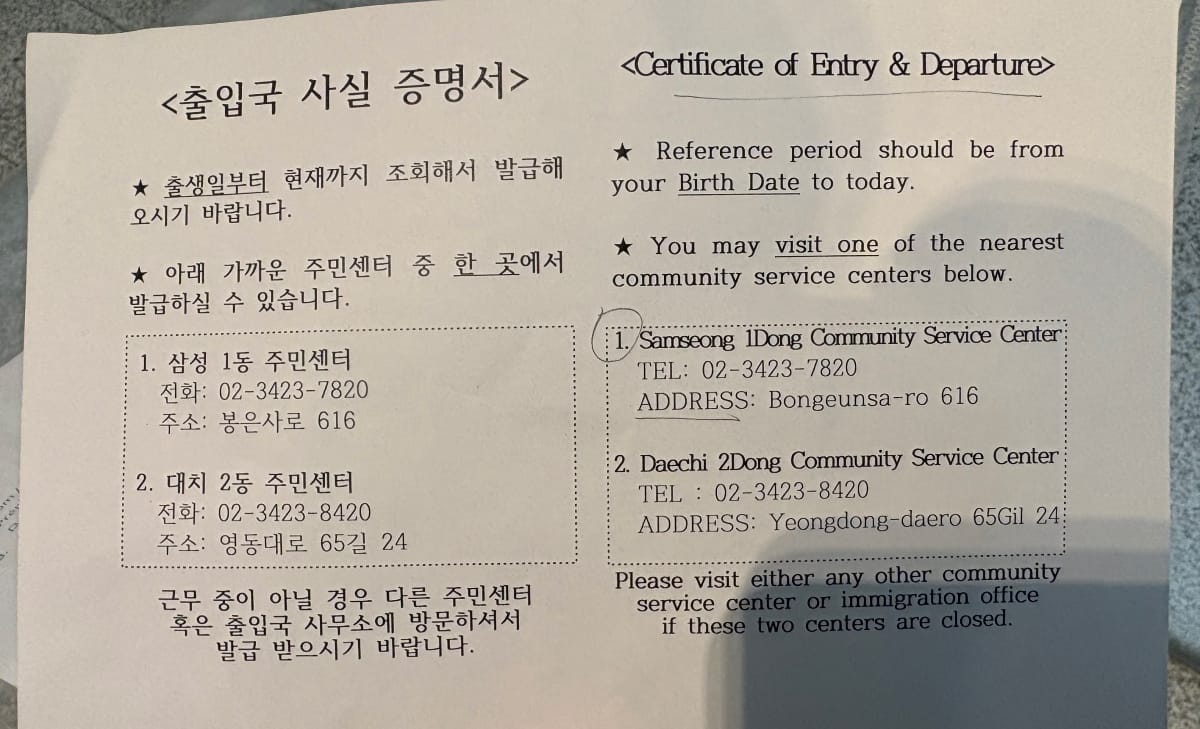
I didn't have it when I showed up. The staff handed me a printed sheet with the two nearest community service centers on it and sent me off.
Two things that make this much less painful than it sounds:
- The reference period must be from your date of birth to today. Not "the last five years." If you request the wrong range, you'll be sent back.
- You get it at any 주민센터 (community service center), not at immigration. It took a few minutes at the counter and cost 2,000 KRW. If the nearby centers are closed, an immigration office can also issue it.
For the Gangnam Driver's License Examination Office specifically, the two closest are Samseong 1-dong Community Service Center (봉은사로 616) and Daechi 2-dong Community Service Center (영동대로 65길 24).
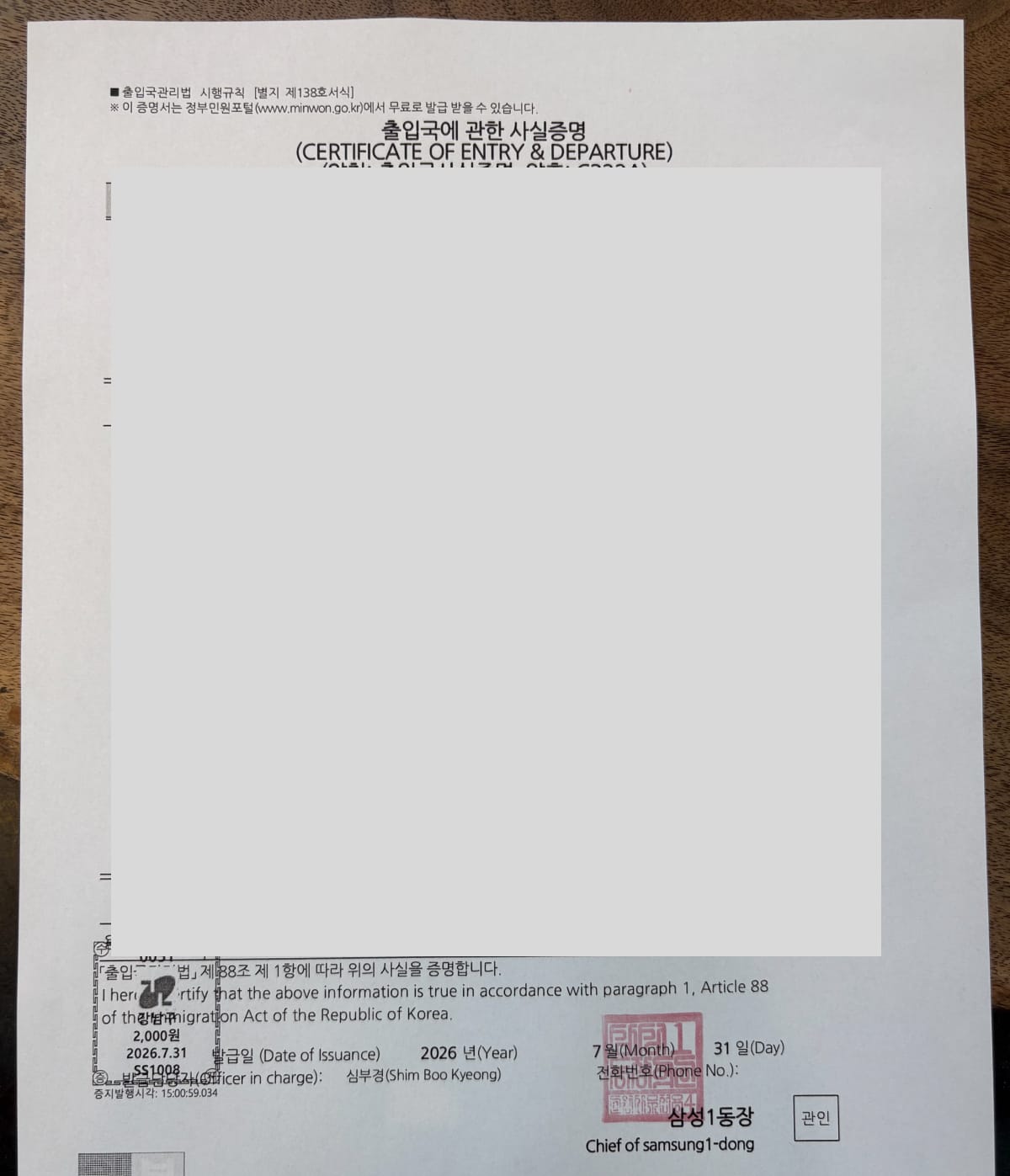
Honestly, if I were doing it again I'd just get this before going. But if you forget, it's a 30-minute detour, not a lost day.
Step by step at the license center
I went to the Gangnam Driver's License Examination Office (강남운전면허시험장), chosen on the strength of its reputation for being the most English-friendly center in Seoul. That held up. The signage at the foreign license counter is bilingual, the forms come in English and Korean, and the staff deal with foreign applicants constantly enough that nothing about my paperwork surprised them. If your Korean isn't strong, this is the one to go to.
Seoul also has a Seobu location, and Busan, Incheon and Daegu centers handle foreign applicants. Not every branch runs the same way, so it's worth calling ahead.
Posted hours for license exchange are 9am to 4pm. In practice that seems to be the cutoff for starting an application rather than a hard closing time. I was still being processed at around 4:30pm and the staff were working away quite happily. But I wouldn't rely on that: the process spans three counters on three floors, and if the eye test window or the exchange desk has stopped taking new applicants you're coming back another day. Go in the morning and give yourself room.
Here's the actual flow, which a Dev Korea community member mapped out for me before I went, and which turned out to be accurate end to end:
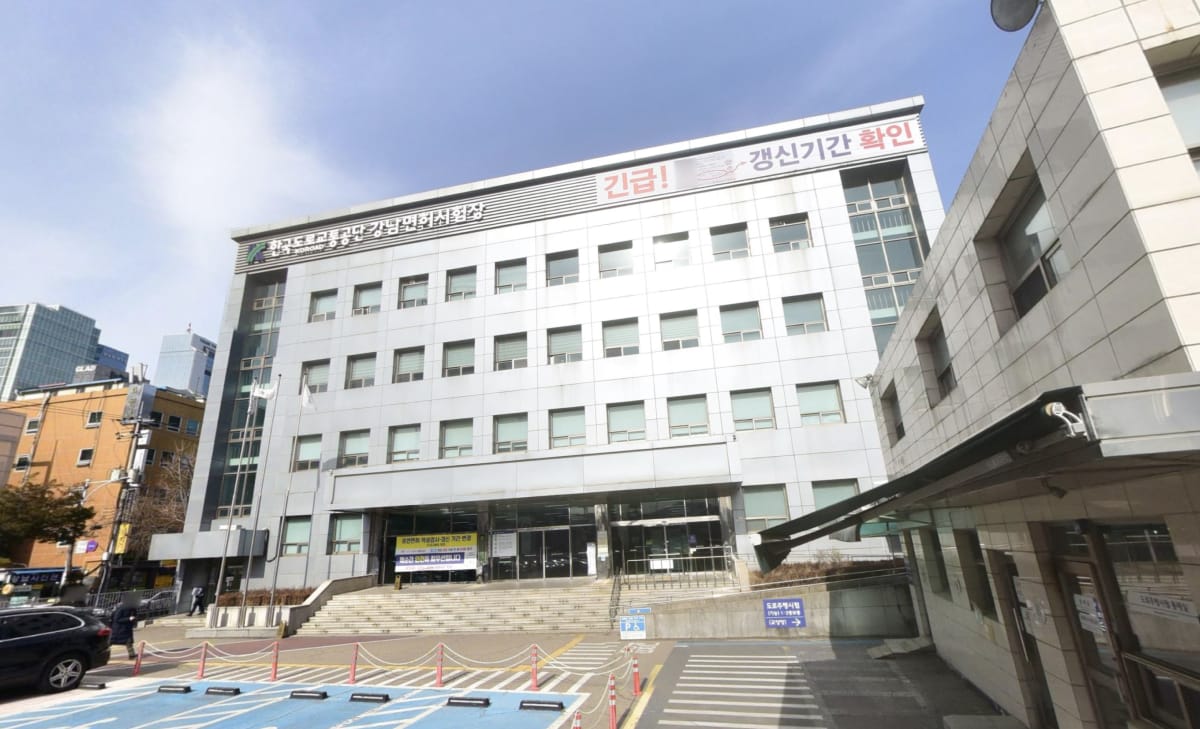
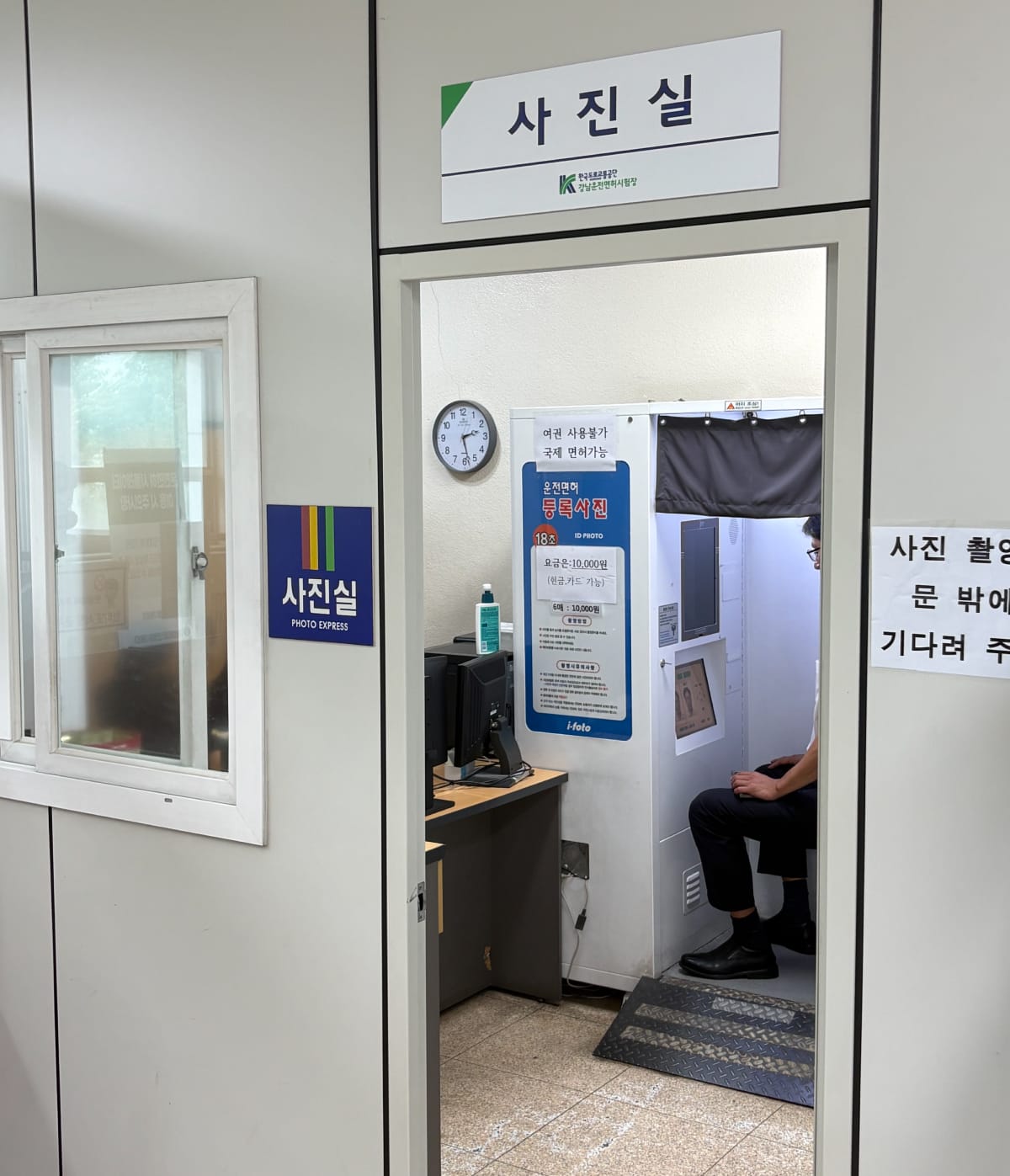
- Photos (2nd floor). If you don't already have photos that meet the spec, there's a booth in the building. Six photos for 10,000 KRW. Skip this step if you brought your own.
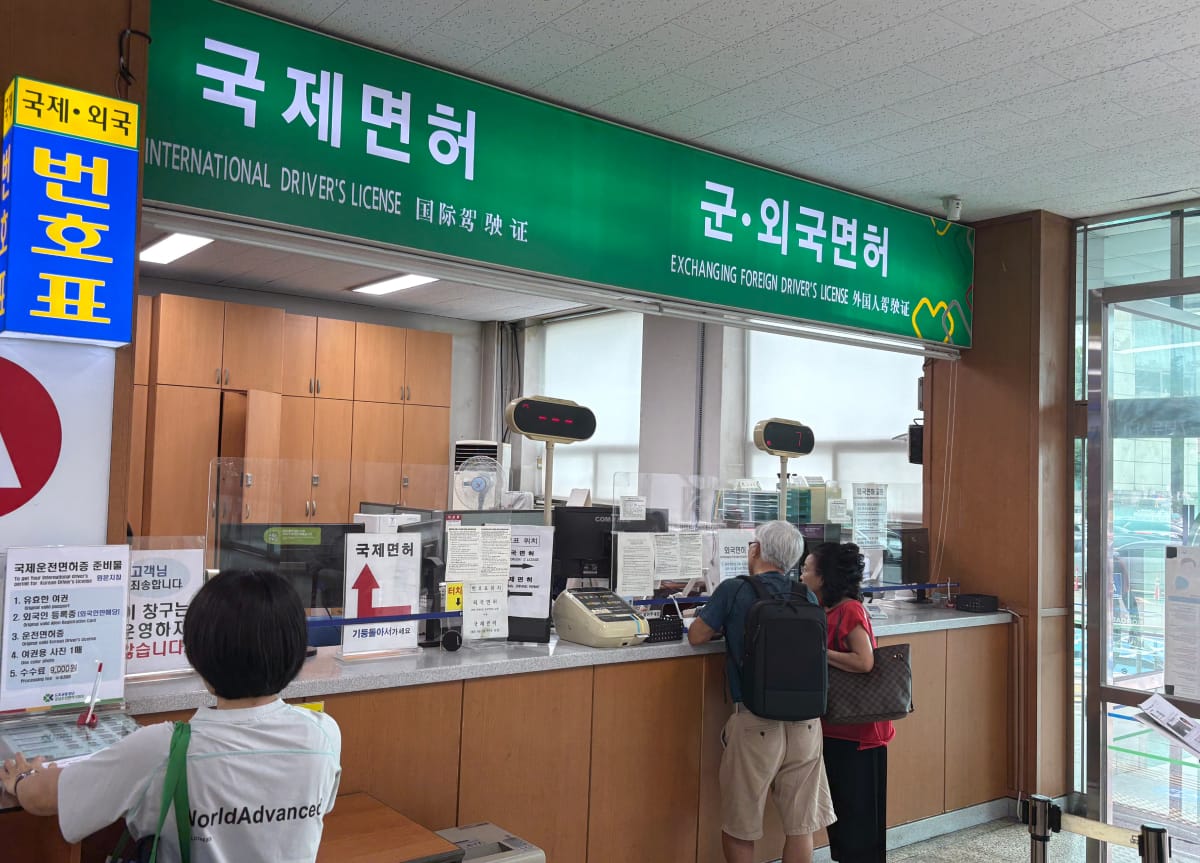
- Foreign license counter (1st floor, right inside the entrance). There's a dedicated line for foreign license applications. In practice there's rarely a queue. Take a number, hand over your documents. The officer checks everything, tells you what's missing or what to sign, keeps the file, and sends you for the eye test.
- Eye test (basement). Pay 6,000 KRW at the window. Stand at the desk, cover one eye at a time, read the lines the examiner points at. Genuinely a 15-second affair. They hand you a sheet with the result.
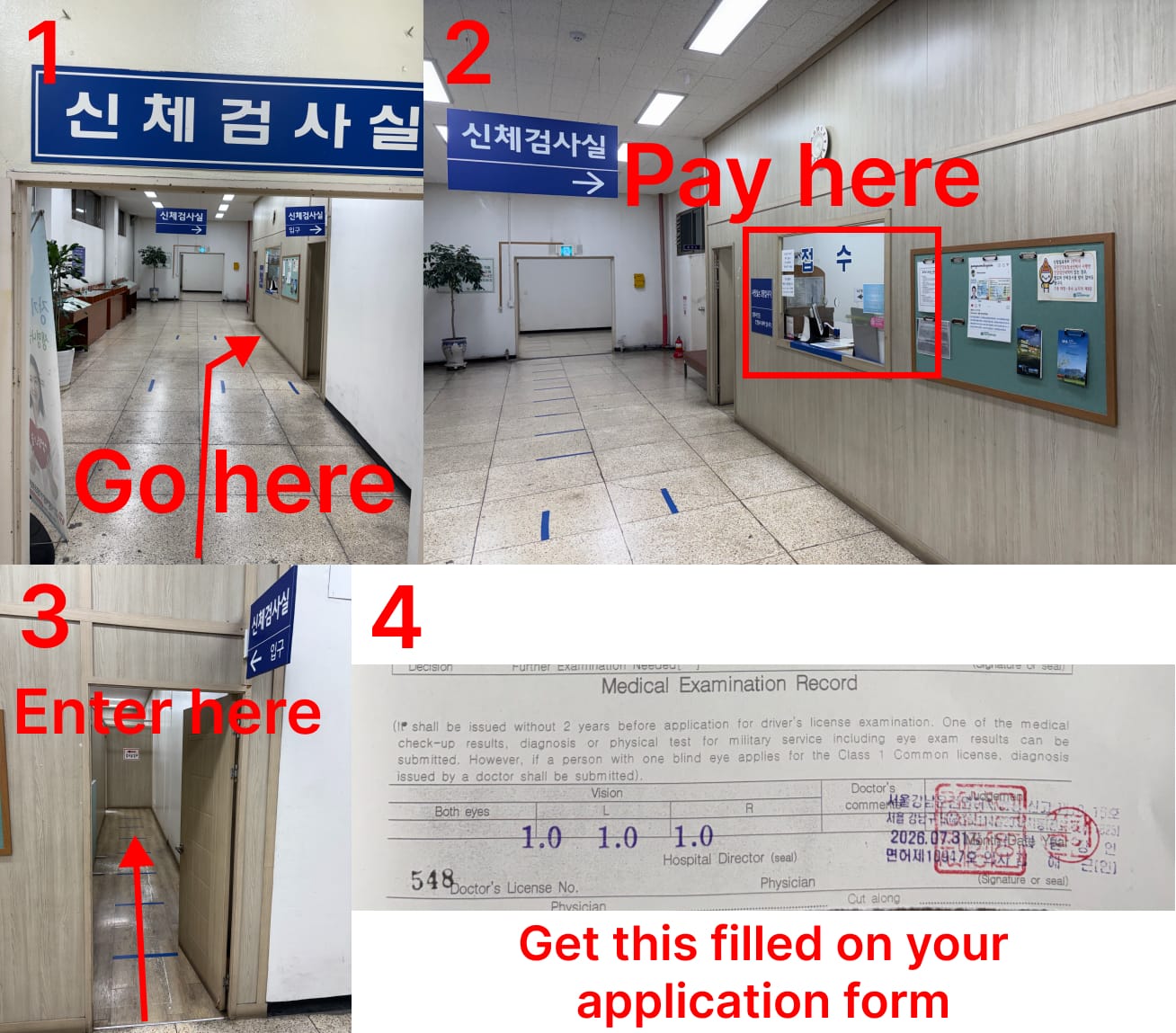
- Pay the issuance fee (back on the 1st floor). 10,000 KRW for the standard physical card, or 15,000 KRW if you also want the mobile ID version, the same system as the mobile ARC. I paid the 15,000 and would recommend it; the physical card is what you scan to activate the digital one.
- Wait for your name (1st floor, opposite side near the water cooler). Names come up on a large monitor. You collect the physical card there.
If you paid for the mobile version, the setup happens afterwards on your phone. Download the 모바일 신분증 app, verify your identity and set a PIN, then scan the IC chip in your new physical card to register it. Korea's mobile driver's license can also be carried in the Naver app now, and the mobile ID carries the same legal force as the plastic card.
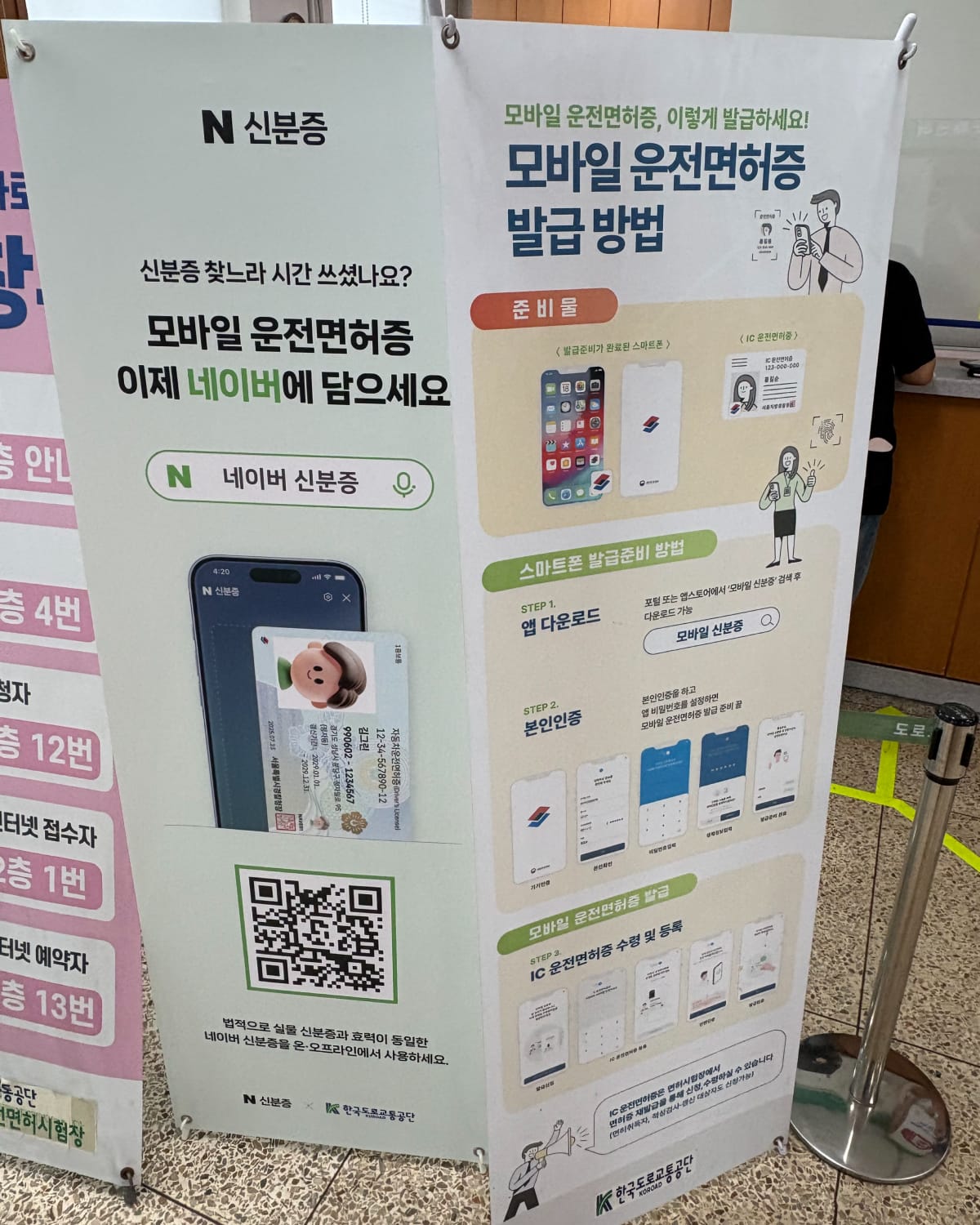
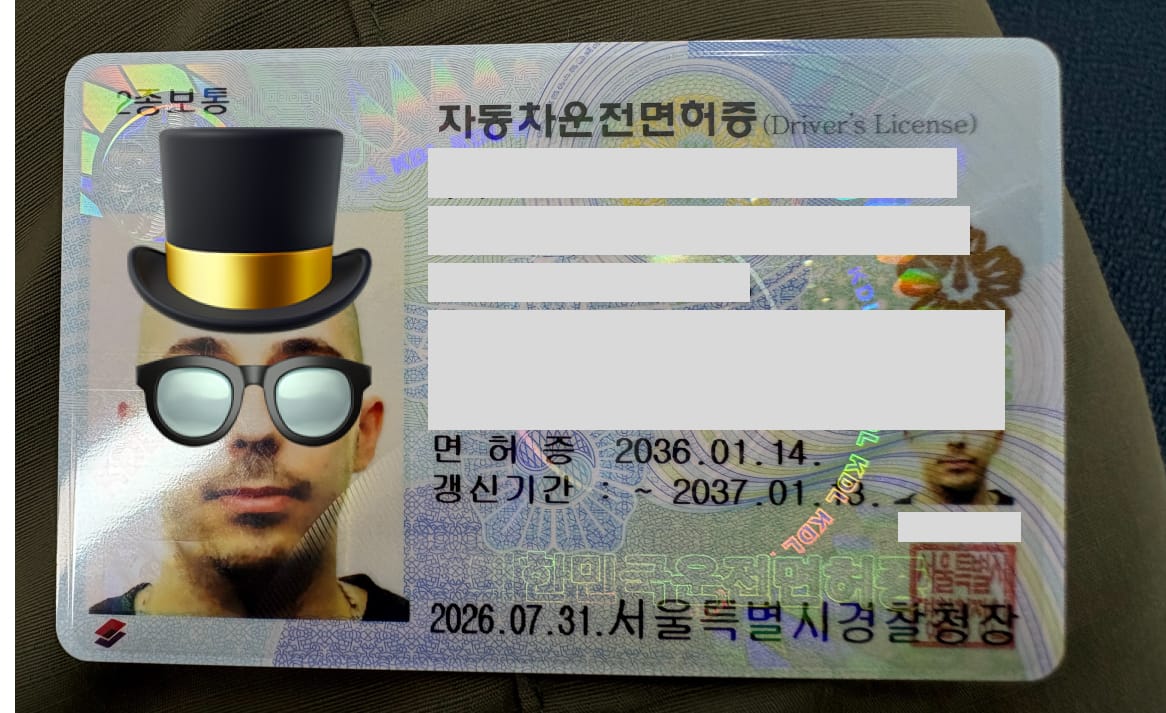
Then you're done. You walk out with a Korean driving license the same day.
What happens to your foreign license
At the counter you sign a Foreign License Exchange & Termination Agreement (외국면허 교환 및 폐기 동의서). It's a single page asking for your name, ARC number, issuing country, foreign license number, issue and expiry dates, whether you hold or have previously held a Korean license, and your purpose of visit to Korea. You sign it under penalty of perjury.
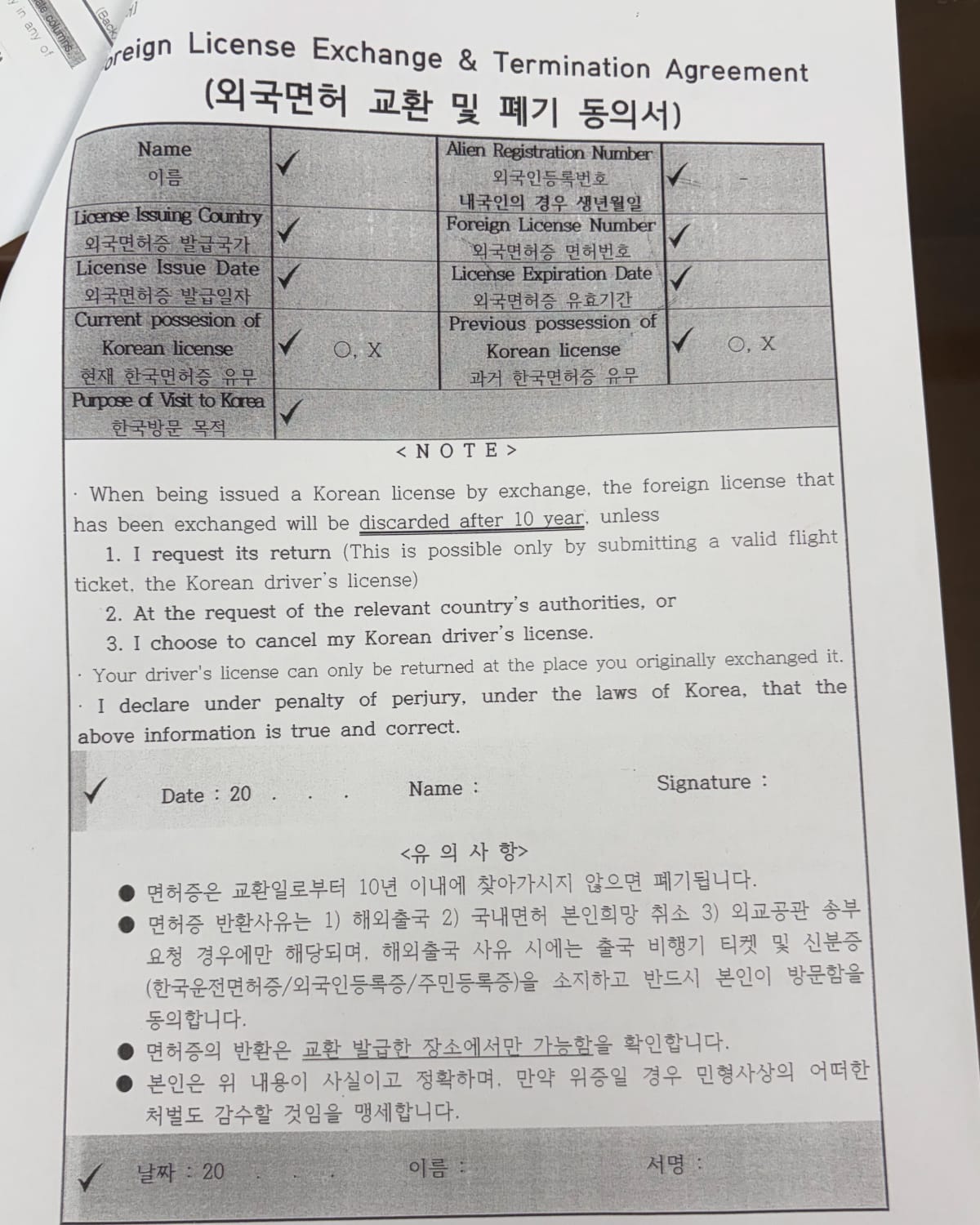
Read the note section before you sign, because this is the part people misunderstand. Your surrendered license is held for 10 years and then destroyed if nobody claims it. Within that window, there are exactly three ways to get it back:
- You request its return when travelling abroad. You need to go in person, show your Korean driver's license, and hand in a confirmed, printed flight ticket.
- The authorities of the issuing country request it.
- You cancel your Korean driver's license, voluntarily giving up the license you just exchanged for.
A poster at the counter puts it more bluntly than the form does:
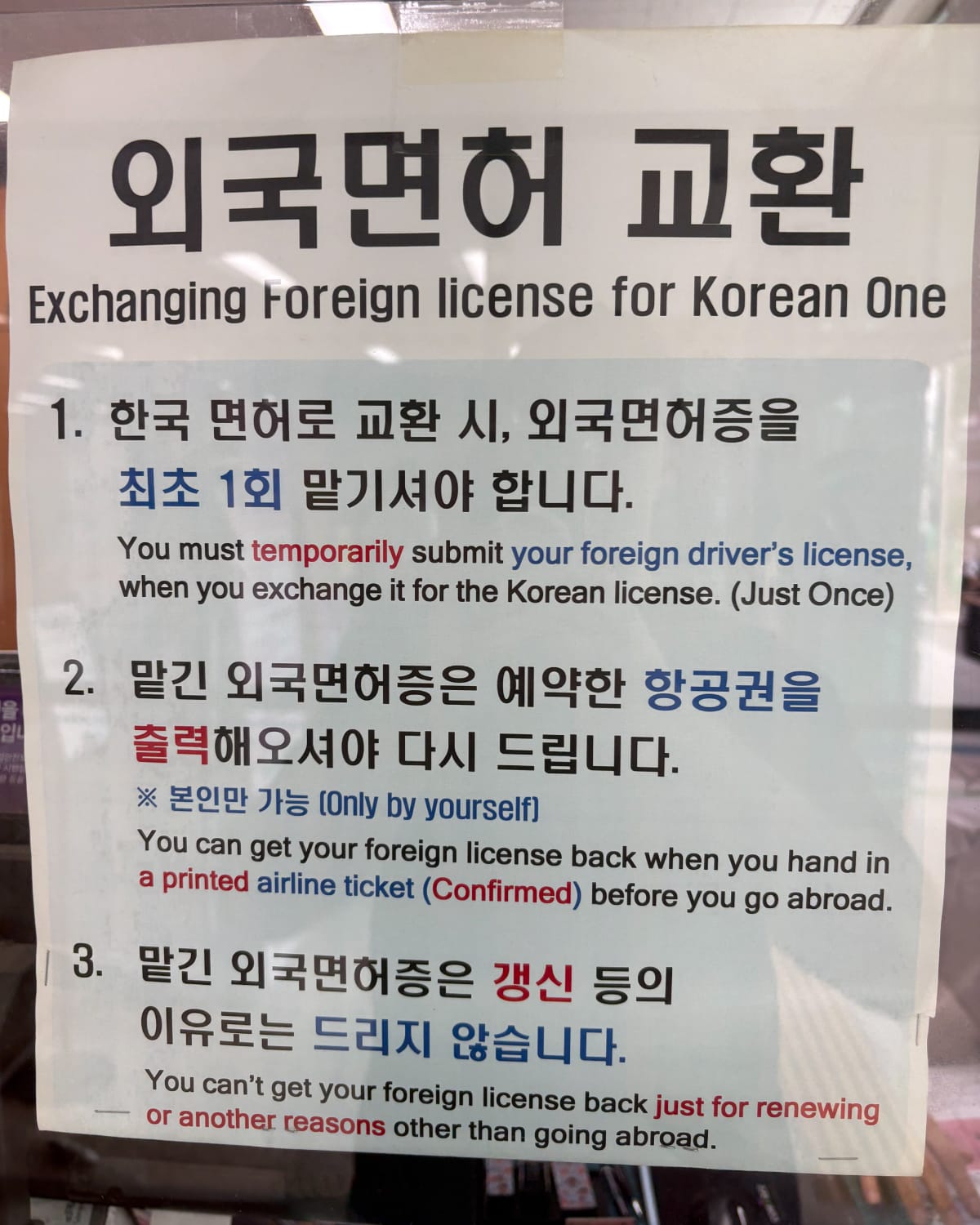
Three things it makes explicit:
- You surrender the license once, not every time. The Korean office describes this as a temporary submission.
- Nobody else can collect it for you. 본인만 가능, in person only.
- Going abroad is the only accepted reason. You cannot retrieve it to renew it back home, or for any other purpose.
That last point is the one to sit with. If your French license is approaching expiry and you were assuming you could fetch it, renew it in France and carry on, that's not on offer. It comes out of the drawer when you have a boarding pass, and not otherwise.
Note also that this is departure abroad, not emigration. You don't have to be leaving Korea forever, but you do need a confirmed ticket in hand, which rules out casually collecting it on a quiet afternoon.
One more detail that's easy to miss: your license can only be returned at the office where you exchanged it. If you did the exchange in Gangnam and later move to Busan, that's a trip back to Seoul.
In practice, for most people this means accepting that the Korean card is now your license for the duration of your stay. If you go home once a year and want to drive there, plan around it rather than assuming you can pick your old license up on the way to the airport.
A reassuring note for French citizens specifically. If you eventually move back to France for good, you don't actually need the physical card sitting in the drawer in Gangnam. Because you originally passed your test in France, you can apply for rétablissement de vos droits à conduire within the year following your resettlement, and your Korean license is recognised in France during that window. If you'd passed your test in Korea instead, you'd exchange the Korean license for a French one, which requires at least 6 months of residence in Korea.
One thing to handle before you leave Korea, though: that process needs a French translation of your Korean license and of your driving record certificate (운전경력증명서). The record certificate has to be collected in person at a police station in Korea, and the French Embassy has been explicit that they cannot send it to you afterwards. Pick it up while you're still here.
What it actually cost
| Item | Cost |
|---|---|
| Certificate of Entry & Departure (출입국사실증명서) | 2,000 KRW |
| 6 photos at the on-site booth | 10,000 KRW |
| Eye test | 6,000 KRW |
| License card (physical + mobile) | 15,000 KRW |
| Total at the license center | 33,000 KRW |
| French Embassy certificate (registered on consular register, what I paid) | 69,720 KRW |
| French Embassy certificate (not registered) | 139,450 KRW |
| Total, my case | 102,720 KRW |
Under 35,000 KRW at the center itself. The embassy certificate is by far the largest line item, and it more than doubles if you're not on the consular register. Amounts can change monthly, so confirm before sending your money order. If you're not French, check your own embassy's current fee, or the apostille cost from your home country.
One note on the official numbers: the notice at the counter quotes a processing fee of 16,000 KRW without the written test, or 26,000 KRW with it. That 16,000 is the 6,000 eye test plus the 10,000 standard card. I paid 21,000 because I opted for the 15,000 mobile version instead of the 10,000 plain card. So if your country is exempt from the written test, budget 16,000 to 21,000 at the center, plus photos if you need them.
Things I'd tell someone starting this today
- Start with the embassy certificate or apostille, and start it early. Everything else can be sorted in a single morning. This one has real lead time. For French citizens it's an ADCS from France plus a postal round trip with the embassy. If your embassy no longer issues certificates, it's an apostille arranged from your home country, which is slower again.
- French citizens: register on the consular register. It halves the certificate fee, from 139,450 to 69,720 KRW.
- Bring originals of everything. Passport, ARC, license. Copies won't do.
- Get the entry/exit certificate before you go, with the reference period set from your birth date. 2,000 KRW and five minutes at any 주민센터.
- You cannot send someone else. Proxy applications aren't accepted, so you have to show up in person.
- Mind the two expiry windows. The embassy certificate or apostille is valid for 1 year from its issue date. The entry/exit certificate is valid for only 2 months. Get the embassy document first, the entry/exit certificate last.
- Go in the morning. The exchange counter runs 9am to 4pm.
- Check your passport has your most recent entry stamp, since the notice specifically asks for it.
- Accept that you're giving up your home license. It's recoverable, but only with an outbound flight ticket, only in person, and only at the office where you exchanged it. For the duration of your stay in Korea, the Korean card is your license.
Your country may work differently
I want to be clear that this is one nationality's experience. France has a straightforward mutual recognition agreement and an embassy in Seoul that still issues license certificates, which puts me in the easier category, even if that certificate costs more and takes longer than anything else in the process.
Beyond that, the variation is real and I'm not going to pretend to summarise it. Some countries exchange for an equivalent license type rather than the default class. Some appear on the acknowledged-countries list but still require the written exam, including certain US states. Which embassies issue certificates changes. Any list I published today would be quietly wrong within a year, and you'd be the one making a wasted trip on the strength of it.
So for your own case, go to the source: KOROAD's English guidance on license exchange for the acknowledged-countries list and document rules, your embassy for the certificate question, and the license center itself for anything the first two leave ambiguous. KOROAD advises contacting the regional office in advance regardless, since the exchange takes time to process.
Final thoughts
The license center staff deal with foreign applicants constantly, the foreign license lane is quick, and the whole on-site portion is a single morning.
The difficulty is entirely front-loaded into two documents: the embassy certificate and the entry/exit record. Sort those out first and the rest is a formality.
Note: KOROAD requirements, acknowledged-country lists, embassy services and fees change. Verify current requirements with KOROAD's English license exchange guidance or your nearest Driver's License Examination Office before you go. This article is for informational purposes only and is not legal advice.
Ready for your next move?
Visit Dev Korea to explore the latest job openings at dev-korea.com/jobs, or if you're hiring, post a job at dev-korea.com/post-a-job and connect with our growing international tech community.