



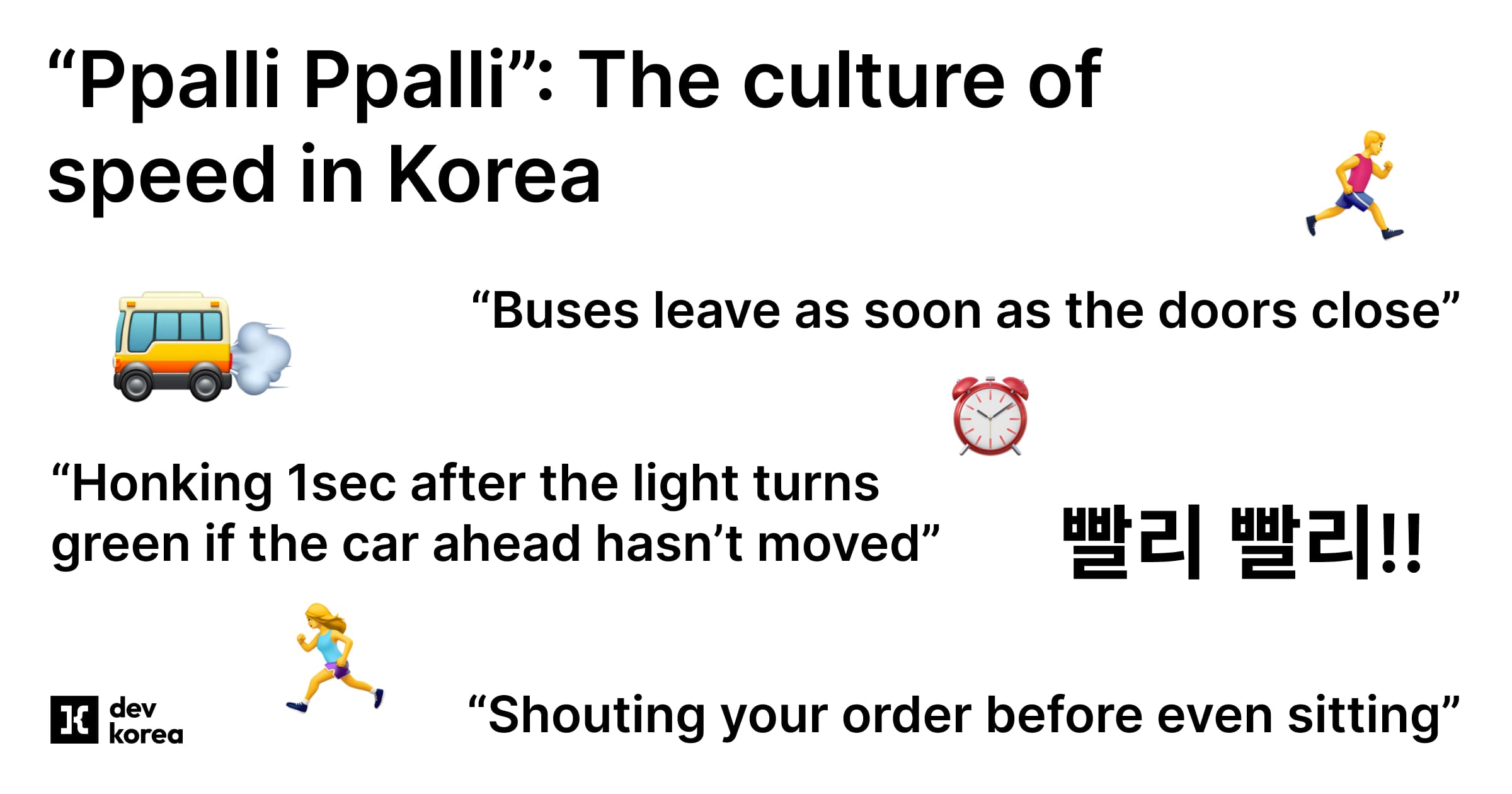
🇰🇷 "Ppalli Ppalli": The culture of speed in Korea
이 글은 한국어로도 제공됩니다. 한국어로 읽기 →If you spend even a few days in Korea, you will hear it everywhere:
"빨리 빨리!" (Ppalli Ppalli!)
It literally means "quickly, quickly."
But culturally, it means much more.
1. What is "Ppalli Ppalli"?
"Ppalli" means fast in Korean. Saying it twice emphasizes urgency.
Over time, it became shorthand for a cultural mindset: do it fast, move quickly, don't waste time.
Speed is especially valued in the service industry. Food arrives quickly. Deliveries come the same day. Public services move efficiently.
Fun fact: Korea's country code is +82.
In Korean pronunciation, 8 is "pal" and 2 is "i", which sounds a bit like "pal-i" (ppalli).
It's not the origin of the term, but many Koreans enjoy the coincidence.
2. Where did it come from?
Some Korean linguists suggest that "ppalli ppalli" culture may be linked to Korea's strong tendency toward uncertainty avoidance — the desire to reduce ambiguity and instability as quickly as possible.
Historically, the Korean peninsula experienced frequent invasions and instability. Later, during the rapid industrialization of the 1960s and 70s, speed became a national priority. Light industry and heavy chemical industries grew rapidly, and both the government and citizens embraced efficiency and acceleration.
Speed wasn't just a preference.
It became a survival strategy, and eventually, a competitive advantage.
3. Everyday "Ppalli Ppalli" moments
What Serin notices
- Pressing the elevator "close" button repeatedly until the door fully shuts
- Honking if the car in front doesn't move within one second after the light turns green
- Standing up and opening overhead bins before the airplane has fully landed
What Florian notices
- The bus driver departing immediately the moment the doors close
- Delivery drivers sometimes bending traffic rules to deliver faster
- Switching supermarket lines constantly to find the one that moves fastest
Shared on our Discord community
- Customers shouting their order before even sitting down
- Passports or visas being issued surprisingly fast
These are small things, but together, they paint a picture.
4. When foreigners start saying "ppalli" too
Interestingly, this mindset does not stay foreign for long.
Many foreigners who live in Korea for years gradually adapt to the "ppalli ppalli" rhythm, often without even realizing it. What initially feels rushed or stressful slowly becomes normal. Waiting starts to feel longer. Delays feel heavier. Speed becomes the default expectation.
The real surprise comes when they return to their home country.
Suddenly, everyday life feels slow.
Customer service takes too long.
Processes feel inefficient.
People seem oddly relaxed about delays that now feel unnecessary.
What once felt exhausting in Korea now feels efficient.
What once felt calm back home now feels frustrating.
In that sense, "ppalli ppalli" is not just a cultural trait you observe. It is a tempo you internalize. Living in Korea quietly recalibrates your sense of time.
Many long-term foreigners end up carrying Korea's speed with them, even after they leave.
5. The advantages of "Ppalli Ppalli"
There's a reason many foreigners are impressed by Korea's speed.
- 🚇 Public transportation runs precisely and reliably
- 🍜 Food and delivery services are incredibly fast
- 🏢 Administrative processes (banking, visas, paperwork) can be highly efficient
In industries with short life cycles, like food service or consumer tech, speed itself becomes part of the value proposition.
6. The downsides
However, speed can also come at a cost.
- People who work quickly, even if slightly inaccurate, may be perceived as more competent
- This mindset can contribute to safety negligence or rushed construction. Several major accidents in Korea, including the Seongsu Bridge collapse or the Sampoong Department Store disaster, are often cited as reminders of what can happen when speed outweighs safety.
- Those who cannot move quickly (children, elderly, or simply people with different working styles) may feel left behind
- Mistakes or failures may be seen as "wasted time" rather than learning opportunities
When speed becomes the primary measure of performance, quality and reflection may suffer.
7. Conclusion: Speed vs. quality in the AI era
Korea's "ppalli ppalli" culture has undeniably fueled economic growth and industrial success.
In fast-moving service industries, speed can be attractive and efficient.
But in industries where craftsmanship, safety, or long-term reliability matter, an excessive focus on speed may reduce overall quality.
In today's IT world, especially with AI accelerating software development cycles, the temptation to move faster than ever is strong.
Yet differentiation increasingly comes not just from speed, but from quality, depth, and thoughtful execution.
Perhaps the future isn't about choosing between speed and quality.
It's about knowing when to move fast, and when to slow down.
Ready to explore your next move? Visit Dev Korea to check the latest job openings, or if you’re an employer, post a job and connect with our vibrant community of tech talent eager to contribute to Korea’s innovation ecosystem.