

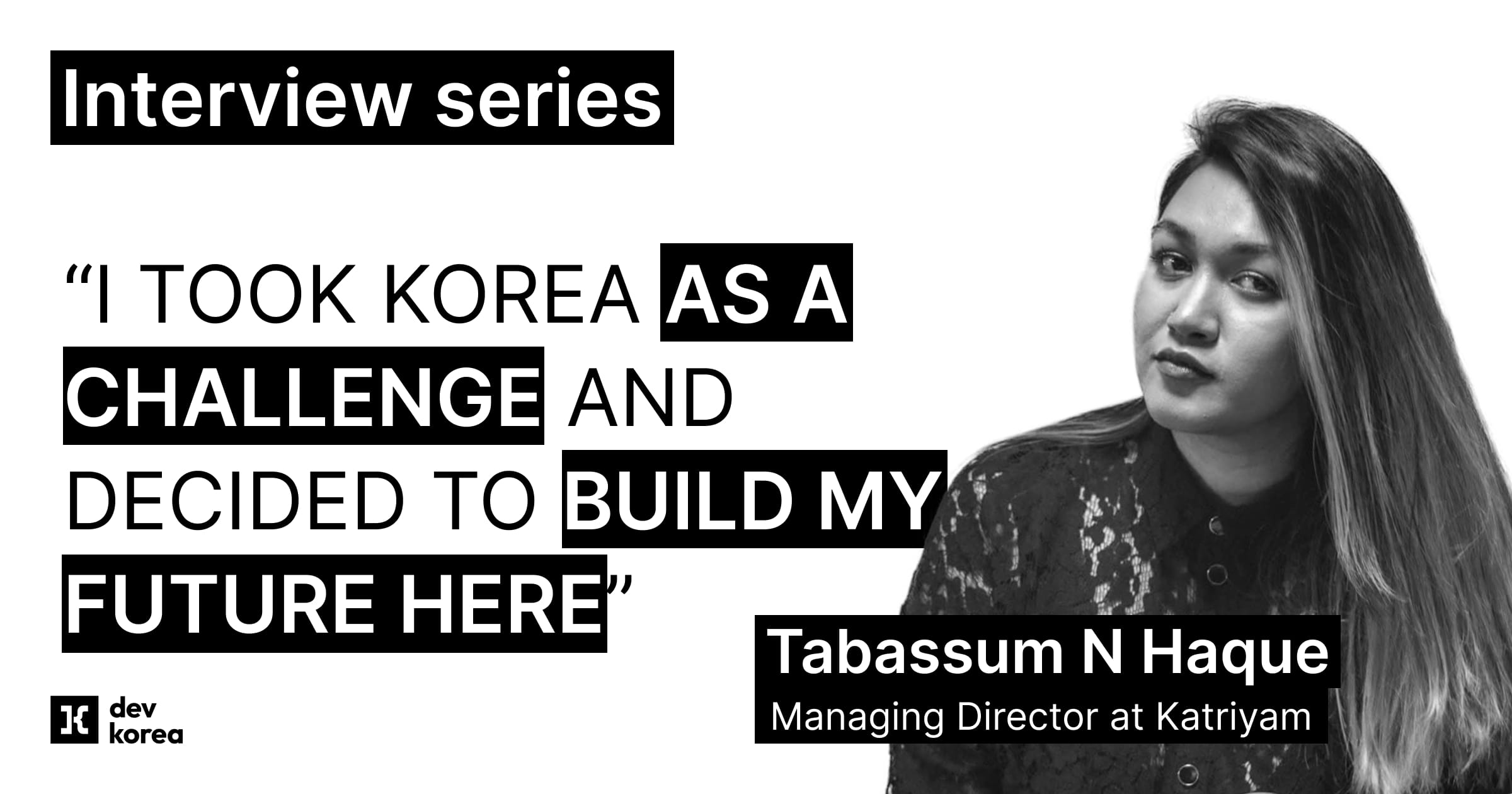
How a Bangladeshi founder built her tech career and startup in Seoul
이 글은 한국어로도 제공됩니다. 한국어로 읽기 →Meet Tabassum, a Bangladeshi co-founder and Managing Director of Katriyam in Seoul. We sat down with her to learn about her journey from Bangladesh to Korea, what it's like working in tech here, and why she believes more global talent should consider a tech career in Korea.
Profile snapshot
- Name: Tabassum N Haque
- Nationality: Bangladeshi
- Current role & company: Managing Director at Katriyam
- Years in Korea: 13+ years
- Visa status: F5 (Permanent Resident)
- Languages spoken: English, Korean, Bengali
- Previous countries worked in (if any): N/A
Background & career
Q. Can you briefly introduce yourself and your current role?
Tabassum: I came to Korea back in 2012 as a Korean Government Scholarship Grantee to pursue my master's degree in Computer Engineering. I have worked in the field of Blockchain and Web3 since 2015, mostly focusing on strategic planning and business infrastructure for the blockchain ecosystem.
Currently I have my own web agency called Katriyam where we provide services to mostly Korean clients. I also work as a blockchain consultant and institutional business developer for BaaS (Blockchain as a Service).
Q. What was your career path before moving to Korea?
Initially I wanted to be in Academia. So, I was mostly working in research labs experimenting with new ideas.
Q. What inspired you to work in Korea?
Honestly, it was mainly because I took it as a challenge. When I was doing my masters, I wanted to go for a PhD after that and eventually become a professor. However, I kept hearing that I chose the path everyone else from Bangladesh in Korea chooses and that I should stick to it, because the corporate world in Korea is very hard and I have to struggle a lot. That initially gave me motivation to actually find a job in Korea.
But honestly, I have to say that I was lucky that I landed an internship in a company that was trying to implement Bitcoin in their e-commerce platform back in 2015. They were way ahead of their time, but it opened a whole new world to me.
Experience working in Korea
Q. Tell us briefly about your company (size, industry focus, notable achievements).
Katriyam is still a small startup. We are a team of 7 people and we focus mostly on Web/App design and development. We also provide A-Z blockchain project incubation starting from project ideation, preparing whitepapers, investor pitch deck, investor connection, consultation about the blockchain ecosystem and which main-net will be suitable for a certain project, writing smart contracts, token listing and beyond. Apart from that, we also have in-house AI experts who have worked and delivered a few interesting AI projects.
Q. How did you find your current job? Was the hiring process challenging as a foreigner?
I can talk about the recent contractual job as a Blockchain Business Developer which I just finished. I think my experience will be a little different than other foreigners. My field is fairly new and most of the companies who are in blockchain and Web3 are startups or SMEs who are expanding a subsidiary to the Web3 field.
As someone who has 10 years of experience in a niche field and can speak both Korean and English, the hiring process doesn't get that hard for me. I mostly never get rejected if I get a job interview. However, getting an interview is the hardest challenge. There are a few job portals where most Korean companies post their jobs, however, they don't mention whether they want a Korean or a foreigner. So, even though I might have the said qualification, I can still get rejected because of not being Korean.
Q. Can you describe your typical workday?
Since I was working at an on-site job until recently, I can share the typical work day based on that. I usually wake up, go to the gym, walk my dog and then get ready for work. I live in Suwon and my workplace is in Seoul. So I have a long commute of 3 hours a day. After I go to work I usually check emails to see if I’ve received any emails from potential partners. I go on to have a few meetings a day both in-house and with clients. As my field's market trend changes on a weekly basis, market research is something which is very important for me. Based on research, we might have to take some decisions to make some tweaks in our market reach. After the whole day of work, many times I have networking events to attend for my own company Katriyam. If I don't have networking events, I get back home and talk to my co-founder, check on the work status of my company and then head to bed.
Q. How does Korean work culture compare to your home country's?
Since I am from Bangladesh which is also in Asia, the work culture isn't that different honestly. We also have a strong hierarchy based work culture. However, the biggest difference is the overtime working culture in Korea. In Bangladesh, people can leave as the clock hits 5pm. But in Korea, staying for longer because the seniors haven't left is something very interesting. Koreans even have a word for it called "Nunchi".
Q. Do you speak Korean at work? How is communication handled in your team?
Yes I mostly use Korean at work. Most of the companies I have worked for are mostly functional in Korean. However, when I am handling overseas partners, I use English.
Q. What challenges have you faced adapting to Korea's work environment?
One of the challenges which most foreigners face is to blend in with Koreans as one of them. They have a hard time accepting that we foreigners are working alongside them although they also need us as much as we need them. So, in the initial days, I tried to mould myself according to their style both mentally and physically. I stopped looking very "Bangladeshi" as it was hard for them to understand the cultural differences. However, as time passed and I made a place for myself, I eventually started being who I am and I hardly face any judgment anymore.
Lifestyle & community
Q. What's your life outside of work like? How have you built your social life here?
Yes, my social life is pretty strong in Korea. I have a very healthy social circle as well as, I meet new people very often to expand my network. I usually have 2~3 social meetups every week. Apart from that, I also like to stay active in terms of working out, volunteering and giving back to Korea which has given me a lot.
Q. How much has knowing Korean (or learning it) helped in your daily life?
Knowing Korean has honestly been life-changing. Not only did it open a lot of new doors of opportunities, it also helped me to understand Koreans to their core. You cannot expect to know a country's people without talking to the people of all levels of a country. I have learnt more about Korea and the emotions of people from randomly talking to street vendors, restaurant owners, taxi drivers and so on. They give you the perspective of a country more than a corporate official.
Q. What was your biggest culture shock when you first arrived?
There were many actually. But if I have to highlight one, it has to be the "ppalli ppalli" culture. As someone coming from a very laid back society, it was overwhelming initially. However, I think I am one of those "ppalli ppalli" people now.
Reflections & advice
Q. Do you plan to stay in Korea long-term, and how do you see your career evolving here?
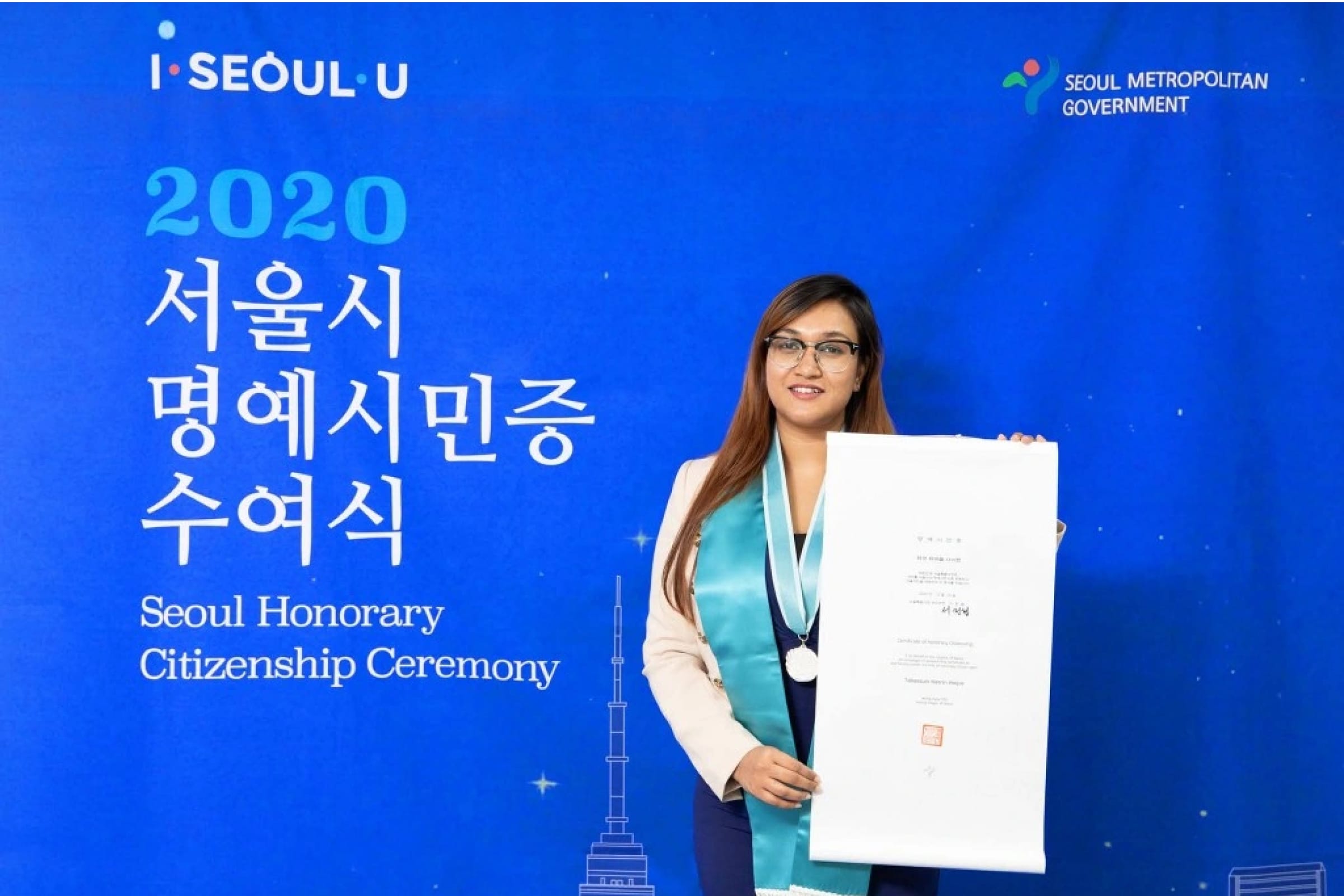
I definitely see having a tie with Korea all my life. I cannot really say I will be here forever or not, but as I have established businesses which are directly tied to Korea, I definitely think I will always be working with Korea and Koreans whether I stay here or leave.
Q. What tips would you give to someone searching for a tech job in Korea?
Making a strong portfolio is very crucial if you are searching for a tech job in Korea. Also, it can be unpopular advice, but take the first low-paid job you are offered. Not because of the money, just to understand Korean work culture so that you know how to move forward with your plan.
Q. What can Korean companies do to better support and integrate international employees?
I honestly think Korean companies need to be aware of the visa process of hiring a foreigner in Korea. A lot of times they promise a visa and then they cannot because they thought it would be easy to provide a visa.
Second would be understanding that different foreigners are coming from different countries. They cannot expect all of us to act a certain way because we all are "foreigners". Being open to understanding the cultural difference and being open to accepting it is very crucial.
Q. Would you recommend Korea to other international tech professionals, and why?
Definitely! Korea can be very hard in terms of work environment and strong hierarchy. But we cannot deny the fact that working in the Korean tech industry is like working for the future! The future which has a higher chance to come into reality and not just "fake promises". The innovations happening in Korea are something the world is looking for. So, if you are tech-savvy, it is always great to try diving into the corporate and business world of Korea.
Rapid fire
- Favorite Korean food: Dak-galbi
- One must-visit place in Korea: Chuncheon (underrated)
- Most surprising thing about Korean tech culture: That one time when the bank was actually providing a loan to buy land in the Metaverse!
- Favorite Korean word or phrase: ppalli ppalli
Connect with Tabassum
- LinkedIn: /in/tabassum-n-haque
- Linktree: /tabassum90
If you want to be next and contribute, send us an email at [email protected].
Ready to explore your next move? Visit Dev Korea to check the latest job openings, or if you're an employer, post a job and connect with our vibrant community of tech talent eager to contribute to Korea's innovation ecosystem.