



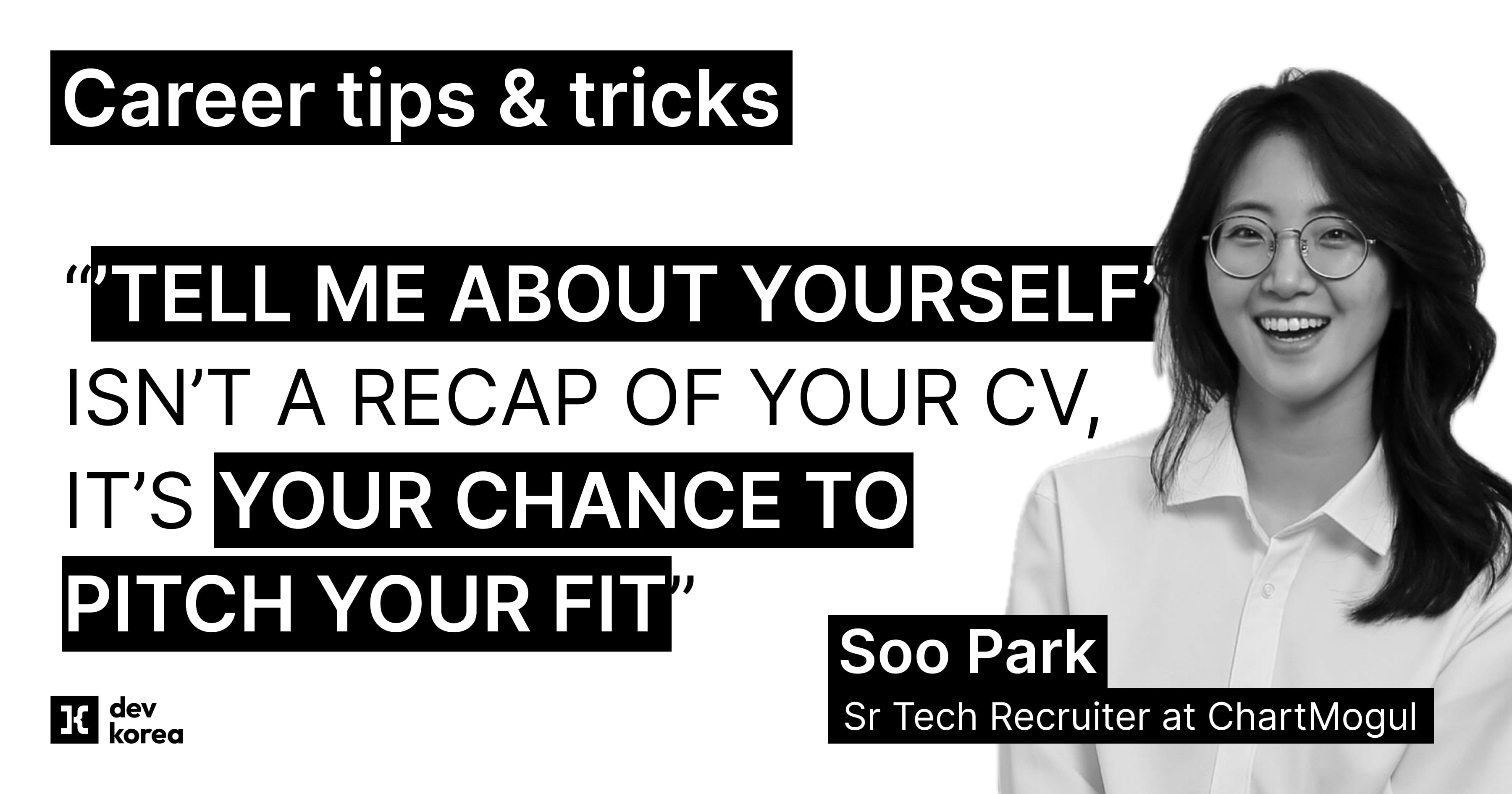
A senior tech recruiter’s guide to the “tell me about yourself” question
이 글은 한국어로도 제공됩니다. 한국어로 읽기 →So tell me about yourself.
A simple question with endless possible answers. It is one of the most dreaded interview questions that almost every recruiter or hiring manager will ask. You may think, “Why are they asking me to walk them through my career when they can read about it in my CV?” And yes, although we may have read through your application before jumping on a call with you, it’s an opportunity for you to pitch yourself beyond your resume and for both yourself and the interviewer to see if there is alignment in 1) the experience and skills the job requires, and 2) values that would lead to positive collaboration.
I’m Soo, a tech recruiter whose career started in San Francisco after graduating from UC Berkeley. I’m currently based in South Korea and working at ChartMogul, a SaaS startup, hiring talent from around the world.
Having conducted over 1,500 initial interviews during my time at ChartMogul, I’ve seen personal introductions ranging from the candidate asking me “What would you like to know?” to telling me their whole life story. The ones who’ve successfully advanced in the interview process exhibited the same patterns during the initial screening:
(Please note that ChartMogul is a remote-first company, so I am speaking from my experience of conducting all interviews over video.)
Stay on topic
Whether you begin by talking about how your passion started at a young age or from your first professional role, be sure not to stray too far from talking about your career and stay relevant to the job that you are interviewing for.
Some candidates go off on long tangents about the complexities of a certain tool or talk in-depth about personal projects that aren’t relevant. Although we understand their intention of wanting to display their knowledge or their diverse experience, this type of verbose, irrelevant introduction can suggest to interviewers that the candidate is likely to over-explain and sidestep during team discussions.
All-inclusive summary
When walking through each of your roles, what the interviewers want to hear is enough details that give them a good picture of what you were doing that is not already written in your CV. This includes the type of product you worked on, your day-to-day responsibilities, the different projects and features you contributed to, the tools you used, the team size, and your role within the team. And if you have any short stints in your career, explaining why you left the company is a good practice.
A well-rounded summary can often answer questions that the interviewers had prepared and allow them to hone in on follow-up questions that make the best use of your interview time.
“Why are you looking for a new role?”
Is a question that most, if not all, interviewers will ask. It is a way for us to understand your motivation and to assess whether there is a long-term fit. Rather than waiting for the interviewer to bring it up, you can naturally incorporate this into your introduction by ending it with why you are looking for a new opportunity and what excites you about the job or the company you’re applying for.
The STAR method
After you’ve pitched yourself, the interviewer will ask more in-depth questions about specific projects or behavioral questions, for which you’ll be expected to provide concrete examples from past experiences. Try to structure your responses using the STAR method:
- Situation: Set the scene and give enough context, such as what company it was for, why the feature was needed, who was involved, etc.
- Task: Describe your responsibilities and any challenges you faced.
- Action: Explain the actions you took and how you carried them out.
- Result: Share the outcome of your work and highlight any quantifiable achievements.
However, we understand that it can be difficult to remember specific examples in a high-stress situation like an interview. In the case that you truly cannot remember and are unable to answer those behavioral questions, turn them into situational questions of “What would I do in that scenario?” and talk about your approach rather than sitting there stumped.
Be prepared
Whether the interview is over phone or video, treat all interviews like an in-person meeting. This means having your devices charged and updated beforehand, looking presentable rather than disheveled as if you had just gotten out of bed, ensuring that your environment is distraction-free, and practicing good body language even through the screens. For video interviews, we highly recommend taking them on a laptop or computer instead of your phone unless that’s your only option.
And if you are running late or dealing with issues that could disrupt the interview, make sure to communicate and email the interviewer ahead of time!
Most importantly: Be genuine and authentic!
Although you may think you’re getting away with it, we can tell when someone has memorized an AI-generated introduction or is reading off of a script on their screen. It’s okay to use your CV as a guide for you to follow and to practice your responses beforehand, but we want to see you be yourself and talk about your experiences naturally.
Engage in small talk, be conversational, and show the kind of person you would be as their future team member.
Here’s an example of what a strong introduction could sound like:
“I’ve been a software developer for over 4 years. I’ve mainly worked in backend with Java, but also have some experience in frontend with React.
My career started at (company name), a software service company, where I joined as a junior developer and grew to mid-level in a year. During this time, I worked with various clients in real estate, e-commerce, and other industries on their needs like building small features, working on websites, etc. I usually worked with 4-5 other developers and collaborated closely with the clients and stakeholders.
I wanted to gain experience in a product company, so I joined (company name) that has a big HRIS system and this is where I learned the most. I was part of the Tooling Team of 12 people including a PM and QA, where we handled an internal tool that was used by all the engineering teams. The biggest project I worked on was an automatic workflow process, where once a task was completed, it would automatically move on to the next step. It took about a month to complete and we shipped it without any major bugs or delays. Besides this, in my day-to-day, I was involved in mentoring new team members, writing documentation, helping with testing, and doing code reviews.
In my personal time, I’ve been trying out other languages like Python and Ruby to expand my horizons. I also like to read about different software architecture. Outside of tech, I enjoy mountain biking in my free time.
Now I’m looking for a new challenge where I’m part of a smaller team and hopefully have a bigger contribution to the company. I’d love to be able to see the direct impact I have on customers who love using the product.”
Connect with Soo
- LinkedIn: /in/y-spark
- Visit ChartMogul: jobs.chartmogul.com/
If you want to be next and contribute, send us an email to [email protected].
Ready to explore your next move? Visit Dev Korea to check the latest job openings, or if you're an employer, post a job and connect with our vibrant community of tech talent eager to contribute to Korea's innovation ecosystem.