



From D-10 to F-2-7 without E-7: What I learned navigating Korea's visa system
이 글은 한국어로도 제공됩니다. 한국어로 읽기 →This article was originally published by Maëlle Dairain on her LinkedIn and is reposted here with her permission. Thanks to Maëlle for letting us share it with the community.
Most foreign professionals in Korea assume the long-term path is linear:
D-2 → D-10 → E-7 → F-2-7 → F-5
That's the common narrative.
In February 2026, I moved directly from D-10 to F-2-7, without ever holding an E-7 visa. I'm sharing this not as a "hack," but as a case study in preparation, timing, and understanding how the system actually works.
🌏 My background
Hi I'm Maëlle, a 24 year-old French woman who discovered South Korea for the first time during an exchange semester in Sungkyukwan University 3 years ago. After graduating from a Master's degree in Engineering (Smart and Resilient Cities) and while working a year in urban project development at Linkcity (Bouygues Construction Group) in France, I made the deliberate decision to come back.
I returned to Korea in April 2024 on a Working Holiday (H-1) visa with a clear goal: build a long-term career here. During that year, I focused on:
- Improving my Korean (until TOPIK Level 4)
- Building a professional network
- Securing relevant work experience
In April 2025, I transitioned to a D-10-1 (job-seeking visa). After a short-term consulting experience at GGGI, I joined Yooshin Engineering Corporation as an intern in September 2025 and signed a one-year contract in January 2026.
One important detail: switching from H-1 to D-10 cannot be done in-country — Korea does not allow this change of status domestically. I ended my H-1 a little earlier than planned, spent two days in Japan, and re-entered Korea as a tourist to apply for the D-10 upon arrival.
First: Understand which pathway applies to you
Before anything else, I want to be clear: this article describes one specific pathway to the F-2-7 visa. The system has multiple routes, and most people will not qualify through the same one I used.
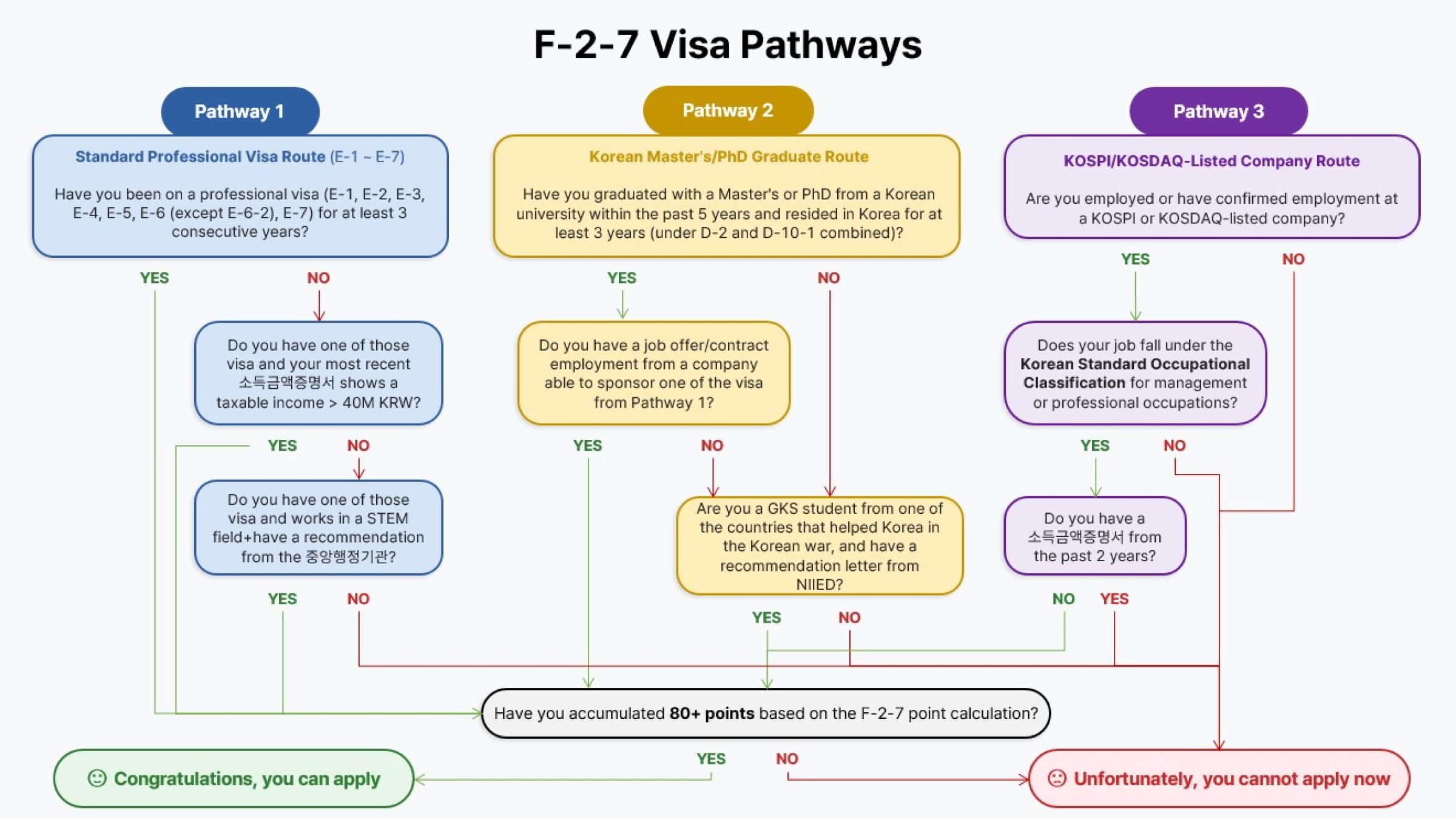
The three main (but not only) eligibility pathways are:
- The standard route (most common): You hold a professional visa such as E-7, E-2, E-3, or similar, have been legally residing in Korea for at least 3 consecutive years under that status, and accumulated enough points. This is what most foreign professionals eventually use. It takes time, but it's well-documented and reliable.
- Korean domestic graduate: You completed a Master's degree or higher at a Korean university, have been residing in Korea for at least 3 consecutive years (with D-2 or D-10-1 visa), and have confirmed employment or are employed under a qualifying professional visa. This is a faster route for those who studied here long-term.
- KOSPI/KOSDAQ employee: You are employed or have confirmed employment at a corporation listed on the KOSPI or KOSDAQ stock markets, in a managerial or professional occupation per the Korean Standard Occupational Classification. If you meet this condition and have enough points, the usual 3-year residency requirement is waived entirely.
🎯 Why I chose F-2-7 over E-7
Honestly, E-7 was my original plan. It's the default answer most people give when you ask "what visa do I get once I have a job in Korea?"
But while researching the E-7 → F-2 pathway, I came across a specific provision I hadn't heard of before: foreign professionals who are employed at a KOSPI or KOSDAQ-listed company may be eligible for the F-2-7 visa directly.
I checked: Yooshin is listed on KOSDAQ!
That changed everything. F-2-7 offered something E-7 couldn't in the short term:
- Independence from employer sponsorship
- Freedom to change jobs without losing status
- A direct path toward long-term residency
- For someone building a career here on their own terms, it was clearly the better option.
✅ What made it possible
The F-2-7 is a points-based system. Here's a rough breakdown of where my points came from:
- Education: Master's degree in engineering
- Age: Age bracket gives more or less points
- Korean language: TOPIK Level 4
- Income: Annual salary (1-year contract)
- Special condition: Employed at a KOSDAQ-listed company
Note: under the standard pathway, income points are calculated from your most recent 소득금액증명서. But under the KOSDAQ/KOSPI pathway, you should not have one, so income is assessed directly from your employment contract instead.
The KOSDAQ condition is significant because it essentially fast-tracks eligibility for professionals at listed companies — but it comes with strict conditions, one of which nearly derailed my application entirely...
⚠️ The obstacle I didn't see coming
I had spent months preparing every document and I went to the immigration office confident.
The officer asked whether I had any declared income in the past two years (here 2023 and 2024). The KOSDAQ-employee pathway requires that you cannot submit a 소득금액증명서 (income certificate) showing any earnings in that period. At the time of my application, the 2025 income certificate was not yet available — it only becomes accessible from May of the following year. That meant immigration needed to verify the two previous fiscal years: 2023 and 2024.
I assumed I didn't have one — I had never held a formal work visa in Korea.
They sent me to the tax office to verify. And there it was: a 소득금액증명서 from 2024 showing an amount under 70,000 KRW. Where did it come from? During my H-1 year, I had animated two cooking classes (two hours each, just giving instructions) for which I was paid a small fee. That was it!
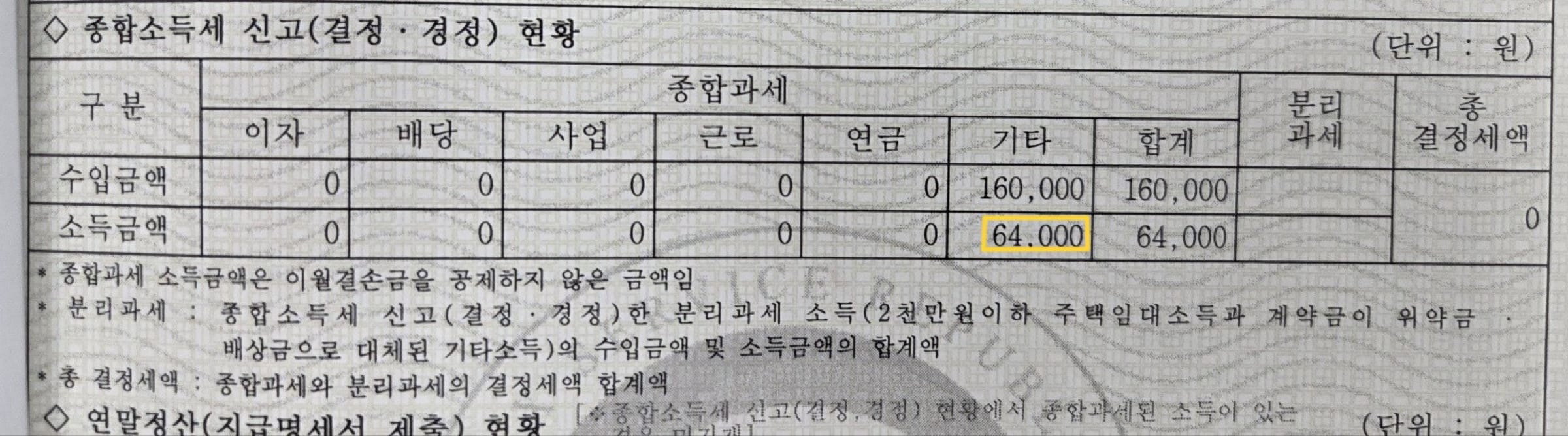
The officer was clear: it doesn't matter how low the amount is. Any recorded income (a part-time shift, a paid SNS post, a small gig) will appear on your 소득금액증명서 and can disqualify you under this specific condition. The amount is irrelevant; the existence of the entry is what counts.
After months of preparation, I walked out of that office without a visa…
The follow-up that changed the outcome
A week later, I went back — this time intending to apply for an E-7.
But my intuition told me to bring up the income certificate issue again and explain the full context. I spoke with a different officer. She reviewed my documents, consulted with a colleague, and acknowledged that while the previous interpretation was technically correct, the amount was so negligible that they were willing to exercise discretion and accept the application.
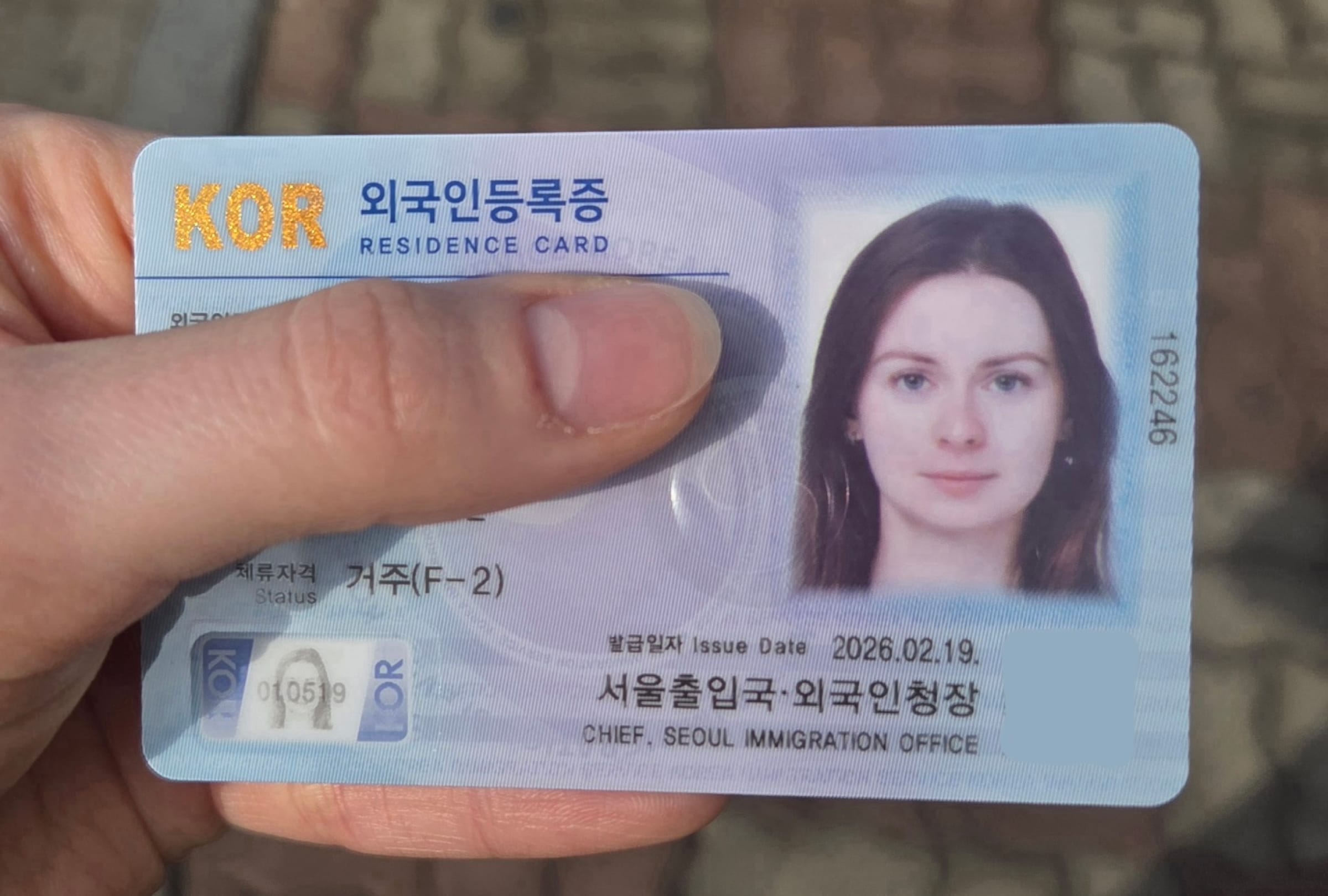
I submitted for F-2-7. It was approved one week later and my new 외국인등록증 (residence card) arrived within two weeks.
Note: because my situation was non-standard, I was granted a 1-year visa rather than the 2-year validity I would have been eligible for based on my salary.
💡 Practical advice for D-10 holders
If you're on a D-10 and trying to figure out your next step, here's what I'd suggest:
- Don't assume E-7 is your only option. If your employer is listed on KOSPI or KOSDAQ, verify whether you qualify for the alternative pathway.
- Run your point simulation early. Understand which documents will be scrutinized most
- Check your tax record before applying. Even minor paid activity during H-1 or D-10 (a part-time job, a cooking class, a paid SNS post, anything) can appear on your income certificate. The amount is irrelevant — the record is what matters.
- Prepare documentation meticulously. Translations, apostilles, contract clarity — details determine outcomes.
- Be persistent, but also be strategic. Avoid being emotional. How you present your case matters.
Risks & honest limitations
This process is not straightforward, and I want to be clear about a few things:
- Immigration officer discretion is real. What one officer interprets strictly, another may handle differently. This creates uncertainty that no amount of preparation can fully eliminate.
- Documentation requirements are strict and specific. Translation standards, apostille requirements, and document formats are not flexible. One missing element can delay or block your application.
- Edge cases like mine may not resolve in your favor. The outcome I described depended on a specific officer being willing to apply judgment. That is not guaranteed.
The F-2-7 via KOSDAQ/KOSPI provision has conditions that need to align precisely. If your income record, contract terms, or point calculation fall slightly outside the criteria, you may need a different pathway.
Final thought
The Korean immigration system is structured, but it's not inflexible. There are pathways that aren't widely advertised, and eligibility conditions that reward people who do their research carefully.
My path from D-10 to F-2-7 wasn't linear. It involved a setback, a second attempt, and a conversation that could have gone either way. What made the difference was preparation, knowing the system well enough to ask the right questions, and the willingness to try again.
If you're planning your next step from D-10 or E-7, research the pathways early — small details can change the entire timeline.
Connect with Maëlle
- LinkedIn: /in/maelledairain
- Linktree: /maelledairain
If you want to be next and contribute, send us an email at [email protected].
Ready to explore your next move? Visit Dev Korea to check the latest job openings, or if you're an employer, post a job and connect with our vibrant community of tech talent eager to contribute to Korea's innovation ecosystem.